Grafting in is a process where a plant is combined with another similar plant to create a kind of hybrid.
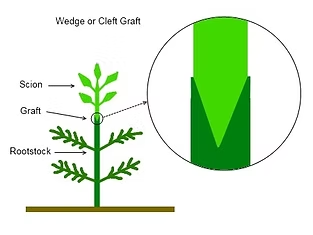
The process is rather simple, the planter cuts the bad or undesired sections off the plant and then attaches the new section with a similar but opposite cut and then secures the “grafted” area with string, tape or a similar method.
The two then grow together, and the new feeds off the old. The old grows into the new and the two become a new kind of plant having some of the attributes of both.
What did Rav Sha’ul, (Paul) Mean?
What did Rav Sha’ul, (Paul) Mean?
Rav Sha’ul who is commonly known as the Apostle Paul, was using the agricultural grafting analogy to the Gentile world. He was trying to explain how they will fit into God’s eternal Covenants within the concepts of the Tanak (Old Testament to some) and the Commonwealth of Israel.
In this analogy, Paul explains how those who had and have fallen away from faith and have not (as yet) come to faith in Yeshua as Messiah, would be “cut off” from the root (Israel) and replaced through the “grafting in” process, with Gentile believers.
He uses the analogy of Israel as the “natural” root and branches and the Gentiles as the “wild” branches which will be grafted into the natural.
This explanation comes up in his letter to the congregation in Rome, chapter 11, Ephesians 2:11-13, Ephesians 2:19, and Ephesians 3:6. He goes into great detail using this analogy of how Israel is the natural root, and through the holiness of the root, the rest of the [olive] tree is holy. However, within the context of this he points out how some of the branches have [spiritually] died and through the grace of God have been pruned or “trimmed” off and the Gentile believers are then ~grafted in~.
19 You will say then, “Branches were broken off that I might be grafted in.” 20 Well said. Because of unbelief they were broken off,
Paul goes on with stern warnings to the Gentiles NOT to become complacent, arrogant, or self aggrandizing in this, puffing themselves up with pride, self assurance and vanities. Pointing out that if God was more than willing and capable of cutting off those already in the body of His people, they too could just as easily be cut off and thrown into the fires.
11 I say then, has God cast away His people? Certainly not! For I also am an Israelite, of the seed of Abraham, of the tribe of Benjamin. 2 God has not cast away His people whom He foreknew.
and…
17 And if some of the branches were broken off, and you, being a wild olive tree, were grafted in among them, and with them became a partaker of the root and fatness of the olive tree, 18 do not boast against the branches. But if you do boast, remember that you do not support the root, but the root supports you. 19 You will say then, “Branches were broken off that I might be grafted in.” 20 Well said. Because of unbelief they were broken off, and you stand by faith. Do not be haughty, but fear. 21 For if God did not spare the natural branches, He may not spare you either.
What did Rav Sha’ul, (Paul) Mean?
Rav Sha’ul who is commonly known as the Apostle Paul, was using the agricultural grafting analogy to the Gentile world. He was trying to explain how they will fit into God’s eternal Covenants within the concepts of the Tanak (Old Testament to some) and the Commonwealth of Israel.
In this analogy, Paul explains how those who had and have fallen away from faith and have not (as yet) come to faith in Yeshua as Messiah, would be “cut off” from the root (Israel) and replaced through the “grafting in” process, with Gentile believers.
He uses the analogy of Israel as the “natural” root and branches and the Gentiles as the “wild” branches which will be grafted into the natural.
This explanation comes up in his letter to the congregation in Rome, chapter 11, Ephesians 2:11-13, Ephesians 2:19, and Ephesians 3:6. He goes into great detail using this analogy of how Israel is the natural root, and through the holiness of the root, the rest of the [olive] tree is holy. However, within the context of this he points out how some of the branches have [spiritually] died and through the grace of God have been pruned or “trimmed” off and the Gentile believers are then ~grafted in~.
19 You will say then, “Branches were broken off that I might be grafted in.” 20 Well said. Because of unbelief they were broken off,
Paul goes on with stern warnings to the Gentiles NOT to become complacent, arrogant, or self aggrandizing in this, puffing themselves up with pride, self assurance and vanities. Pointing out that if God was more than willing and capable of cutting off those already in the body of His people, they too could just as easily be cut off and thrown into the fires.
11 I say then, has God cast away His people? Certainly not! For I also am an Israelite, of the seed of Abraham, of the tribe of Benjamin. 2 God has not cast away His people whom He foreknew.
and…
17 And if some of the branches were broken off, and you, being a wild olive tree, were grafted in among them, and with them became a partaker of the root and fatness of the olive tree, 18 do not boast against the branches. But if you do boast, remember that you do not support the root, but the root supports you. 19 You will say then, “Branches were broken off that I might be grafted in.” 20 Well said. Because of unbelief they were broken off, and you stand by faith. Do not be haughty, but fear. 21 For if God did not spare the natural branches, He may not spare you either.
It is obvious the Jews / Israel are not replaced by the Gentiles but in fact supports the Gentile inclusion. This is emphasized in these next verses where Paul tells of how when the end to their temporary blindness is removed they will become the stabilizing roots of the faith, supporting the Gentiles who have been brought in and out of the rest of the “pagan / secular” world.
“God has given them a spirit of stupor, Eyes that they should not see And ears that they should not hear, To this very day.”
25 For I do not desire, brethren, that you should be ignorant of this mystery, lest you should be wise in your own opinion, that blindness in part has happened to Israel until the fullness of the Gentiles has come in. 26 And so all Israel will be saved, as it is written: “The Deliverer will come out of Zion, And He will turn away ungodliness from Jacob; 27 For this is My covenant with them, When I take away their sins.”
28 Concerning the gospel they are enemies for your sake, but concerning the election they are beloved for the sake of the fathers. 29 For the gifts and the calling of God are irrevocable. 30 For as you were once disobedient to God, yet have now obtained mercy through their disobedience, 31 even so these also have now been disobedient, that through the mercy shown you they also may obtain mercy. 32 For God has committed them all to disobedience, that He might have mercy on all. 33 Oh, the depth of the riches both of the wisdom and knowledge of God! How unsearchable are His judgments and His ways past finding out!
What did Rav Sha’ul, (Paul) Mean?
Rav Sha’ul who is commonly known as the Apostle Paul, was using the agricultural grafting analogy to the Gentile world. He was trying to explain how they will fit into God’s eternal Covenants within the concepts of the Tanak (Old Testament to some) and the Commonwealth of Israel.
In this analogy, Paul explains how those who had and have fallen away from faith and have not (as yet) come to faith in Yeshua as Messiah, would be “cut off” from the root (Israel) and replaced through the “grafting in” process, with Gentile believers.
He uses the analogy of Israel as the “natural” root and branches and the Gentiles as the “wild” branches which will be grafted into the natural.
This explanation comes up in his letter to the congregation in Rome, chapter 11, Ephesians 2:11-13, Ephesians 2:19, and Ephesians 3:6. He goes into great detail using this analogy of how Israel is the natural root, and through the holiness of the root, the rest of the [olive] tree is holy. However, within the context of this he points out how some of the branches have [spiritually] died and through the grace of God have been pruned or “trimmed” off and the Gentile believers are then ~grafted in~.
19 You will say then, “Branches were broken off that I might be grafted in.” 20 Well said. Because of unbelief they were broken off,
Paul goes on with stern warnings to the Gentiles NOT to become complacent, arrogant, or self aggrandizing in this, puffing themselves up with pride, self assurance and vanities. Pointing out that if God was more than willing and capable of cutting off those already in the body of His people, they too could just as easily be cut off and thrown into the fires.
11 I say then, has God cast away His people? Certainly not! For I also am an Israelite, of the seed of Abraham, of the tribe of Benjamin. 2 God has not cast away His people whom He foreknew.
and…
17 And if some of the branches were broken off, and you, being a wild olive tree, were grafted in among them, and with them became a partaker of the root and fatness of the olive tree, 18 do not boast against the branches. But if you do boast, remember that you do not support the root, but the root supports you. 19 You will say then, “Branches were broken off that I might be grafted in.” 20 Well said. Because of unbelief they were broken off, and you stand by faith. Do not be haughty, but fear. 21 For if God did not spare the natural branches, He may not spare you either.
It is obvious the Jews / Israel are not replaced by the Gentiles but in fact supports the Gentile inclusion. This is emphasized in these next verses where Paul tells of how when the end to their temporary blindness is removed they will become the stabilizing roots of the faith, supporting the Gentiles who have been brought in and out of the rest of the “pagan / secular” world.
“God has given them a spirit of stupor, Eyes that they should not see And ears that they should not hear, To this very day.”
25 For I do not desire, brethren, that you should be ignorant of this mystery, lest you should be wise in your own opinion, that blindness in part has happened to Israel until the fullness of the Gentiles has come in. 26 And so all Israel will be saved, as it is written: “The Deliverer will come out of Zion, And He will turn away ungodliness from Jacob; 27 For this is My covenant with them, When I take away their sins.”
28 Concerning the gospel they are enemies for your sake, but concerning the election they are beloved for the sake of the fathers. 29 For the gifts and the calling of God are irrevocable. 30 For as you were once disobedient to God, yet have now obtained mercy through their disobedience, 31 even so these also have now been disobedient, that through the mercy shown you they also may obtain mercy. 32 For God has committed them all to disobedience, that He might have mercy on all. 33 Oh, the depth of the riches both of the wisdom and knowledge of God! How unsearchable are His judgments and His ways past finding out!
All this to show God’s mercy on all who have been disobedient. As the Gospel states “for God so loved the world that He gave His only son that all who believe in Him shall not die…” John 3:16
The Grafted in Symbol

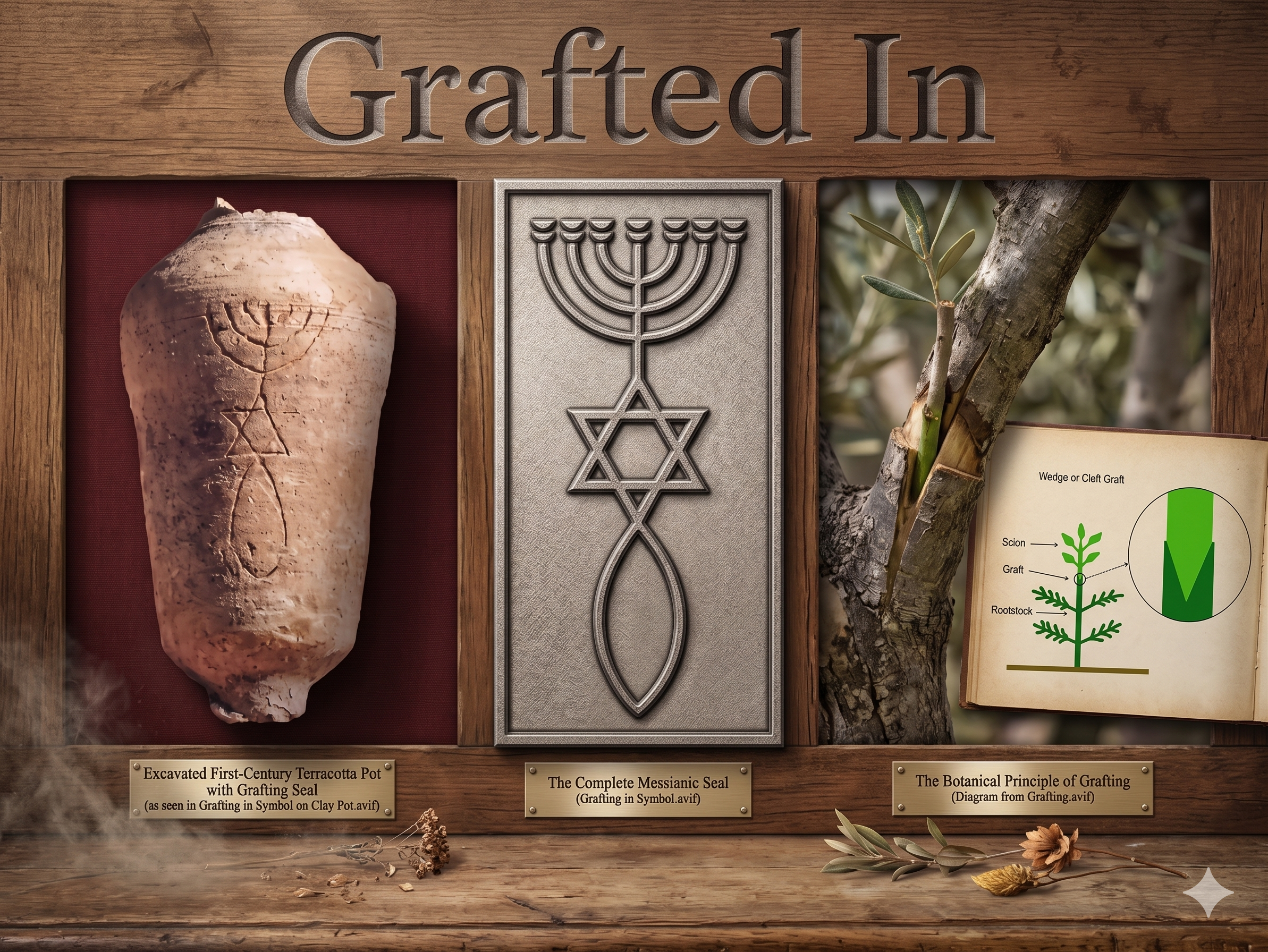
The “Grafted-In” Symbol has reportedly been discovered, in recent years, on pottery in the Jerusalem area, believed to date from the 2nd Century A.D. Some experts have concluded that it was an identifying mark of the early Jewish Believers in Yeshua as a symbol that tied together their traditions and faith in a growing Messianic community.
This sign speaks of the process that is taking place in the lives of both Jew and Gentile. Even though the original branches were broken off and the wild olive shoot grafted in, it is a reminder that now Adonai is grafting back in the original branches and bringing His people Israel back to Himself!
The Menorah at the top represents the Torah, the fulfillment of the promises to Abraham and that special calling to the people of Israel. The Magen David is a symbol of the kingdom and a reminder that the son of David, Yeshua the King, will sit on the throne of David. The fish has a rich history of identification with the believer. It was a common symbol for believers because the Greek word for fish (ICHTHYS) was used as an acronym for “Yeshua, Son of God, Savior”.
This three-part design beautifully illustrates the truth of Romans 11:17-18, that all believers are grafted into the Jewish Root through faith in Yeshua, the Messiah of Israel, the Fulfiller of the Torah and the rightful King in the line of David. Notice that the symbol is “One” – completely fused together. The middle wall of partition has indeed been broken down, and both Jew and Gentile can now come to the Lord and be reconciled through His Atonement. As the Lord is grafting us together and making us one people in Messiah.