Part 3, the claim the Apostles in 33 AD introduced Sunday worship. Acts 20:7 and 1 Cor 16:1-2,
On the surface this may look plausible, but when you delve into the history of the book of Acts
you find this statement on its face is by no means credible. The first day worship could not have been started in 33 AD by the Apostles as alluded to above. The book of Acts and Corinthians were not even written until at least another 30 years later or more.
The book of Acts is not a day by day, year by year accounting of events. The book covers a long span of history of the early movement of believers in Jesus. Then there are only two verses which are referenced to support the alleged change of the Sabbath, if the interpretation of these two verses is correct as being a change in the Sabbath Day, then all of the other verses throughout the Bible regarding the Sabbath Day are wrong. It cannot be both ways. So, let’s look at the two verses which are being cited for support of a first day Sabbath;
Act 20:7 & Cor 16: 1-2 and see what they say in their proper context.
Acts 20:7
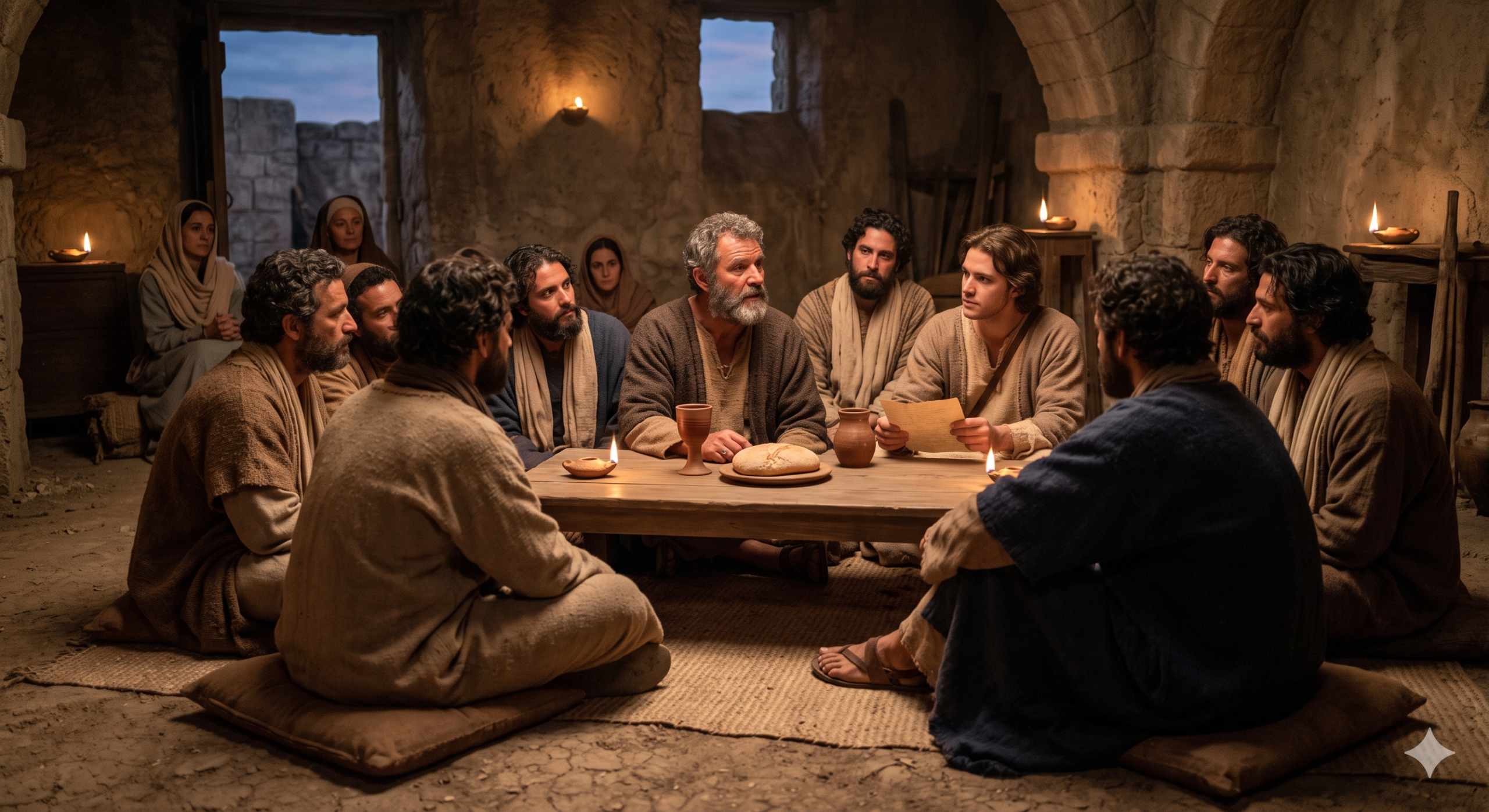
Now on the first day of the week, when the disciples came together to break bread,
If we take this verse and put it in its actual cultural and Biblical context, we come up with a
completely different understanding than what is alluded to. It starts with the citation of “now on the first day of the week”. That would be Sunday; Yom Reeshone. Jesus, the Apostles and disciples who came from Judaea measured their day based on the Creation account in Genesis, “The evening and the morning were the first day”. Thus the day starts at sundown. This would mean the text is referring to sundown Saturday, at the end or conclusion of the Sabbath Day. In the Jewish culture of which Jesus, the Apostles and all of the New Testament (and Old Testament) writers were of, the days were numbered and did not have names as we have today. It should be noted here that the names we have given the days of the week are all exclusively names of pagan gods.
The First Day: Sunday was named after the Sun god.
The second Day: Monday was named after the moon goddess.
The Third Day: Tuesday was named after the god Tyr.
The Fourth Day: Wednesday was named after the god Odin.
The Fifth Day: Thursday was named after the god Thor.
The Sixth Day: Friday was named after the goddess Frigga.
The Seventh Day: Saturday was named after the god Saturn.
Exodus 23:13
“And in all that I have said to you, be circumspect and make no mention of the name of other gods, nor let it be heard from your mouth.
Interesting how far we have strayed from God’s commands!
However, in Judaism they are as mentioned, numbered except for the seventh, that is known as
“The Sabbath Day” or “Shabbat”.
Sunday ————–Yom Reeshone First day
Monday ————-Yom Shaynee Second day
Tuesday ————-Yom Shlee´shee Third day
Wednesday ———Yom Revee´ee Fourth day
Thursday ————Yom Khah´mee´shee Fifth day
Friday —————Yom Ha´shee´shee Sixth day
Saturday ————-Shabbat Rest
When they (the disciples), came together to break bread as in Acts 20, they were doing so on
the first day because as we see in the Biblical passages earlier, as well as others, they were forbidden to make or prepare food during the Sabbath day. They were not changing anything but obeying the seventh day Sabbath by NOT preparing food! Just as when in the wilderness God gave them sufficient food on the sixth day so they wouldn’t have to gather on the Sabbath. The Bible commands that on 10/27/2019 the sixth day they prepare enough food for two days, so food does not have to be prepared on the seventh. They were obeying Torah! They were observing the seventh day Sabbath!
Once again God reinforces the Seventh Day Sabbath which the Apostles and Disciples regularly
kept. It must be kept in mind that the day ended at sundown, so the first day began after their Sabbath worship had ended, and the Sabbath Day had concluded. (Saturday sundown, evening)
This reference to the concept that the Sabbath was changed from the seventh to the first day by this passage completely ignores Biblical and Cultural context. If you consider the actual context, what happened was they were done with Sabbath worship and gathered together that evening for dinner which is referenced by Paul in 1 Cor11:21).
So, after Shabbat they went and got food and “gathered together” to eat. This story clearly
references an “end of day” meal, not a breakfast or lunch (by modern standards). It was what we
would understand as a Saturday evening meal. But by Jewish standards, it was happening on the First Day. The Sabbath had ended at sundown and the new day begun. They had obeyed the seventh day Sabbath! They did not re-establish the Sabbath Day to the first day, Sunday.
The second of the two NT references to the “First Day”.
1 Corinthians 16:1-2
Now concerning the collection for the saints, as I have given orders to the churches of Galatia,
so, you must do also: On the first day of the week let each one of you lay something aside, storing up as he may prosper, that there be no collections when I come.
Once again this does not state in any way shape or form a change from the seventh day Sabbath worship to the first day, unless the focal point of the worship is money. In reality, all it does is reinforce the seventh day Sabbath just as it was in the other verse presented. Sha’ul which the book of Acts says, “was also called Paul” (his name was also NEVER changed), an extremely well educated rabbi who studied under the famous rabbi Gamliel, is reinforcing the Sabbath by having them collect their donations on the first day and NOT on the Sabbath when they were regularly gathering. Paul was obeying the Torah! They were NOT to do what is forbidden on the Sabbath, that of doing business, handling money etc. He was teaching the instructions or Torah of God to them in ways the Gentile world would easily understand and accept.
As for should “Christians” celebrate the Sabbath of the Lord? Consider Isaiah 56 where those
who are not of the bloodline of the Children of Israel, who in the OT are referenced to as “Foreigners who join themselves to the Lord”, (Gentiles, ergo what was to become Christians): Paul explains how the “Christian” believers are grafted into the Commonwealth of Israel by their belief and faith in Jesus. His discussion on this in his letter to the Romans goes into great detail about the grafted in process and the admonition to not count one superior to the Jews.
Isaiah 56:6
“Also, the sons of the foreigner (us Gentiles)
Who join themselves to the Lord, to serve Him,
And to love the name of the Lord, to be His servants—
Everyone who keeps from defiling the Sabbath,
And holds fast My covenant—
Even them I will bring to My holy mountain,
And make them joyful in My house of prayer.
Their burnt offerings and their sacrifices
Will be accepted on My altar.
For My house shall be called a house of prayer for all nations. ”The Lord God, who gathers the outcasts of Israel, says, “Yet I will gather to him others besides those who are gathered to him.”
Here is a chart showing just how much the Apostles and Paul actually KEPT the Sabbath Day.
This by far out numbers the vague passages cited as alleged evidence that any of them actually
changed the Sabbath Day.
Note God’s opinion on disobeying His Sabbaths:
Ezekiel 20:
12 I gave them my shabbats as a sign between me and them, so that they would know that
I, Adonai, am the one who makes them holy. 13 “‘But the house of Isra’el rebelled against me in the desert. They did not live by my laws; and they rejected my rulings, which, if a person does, he will have life through them; moreover, they greatly profaned my shabbats. Then I said I would pour out my fury on them in the desert, in order to destroy them. 14 But concern for my own reputation kept me from letting it be profaned in the sight of the nations who had seen when I brought them out. 15 Yet I also raised my hand and swore to them in the desert that I would not bring them into the land I was giving them, a land flowing with milk and honey, the most beautiful of all lands; 16 because they had rejected my rulings, did not live by my laws and profaned my shabbats, since their hearts went after their idols. 17 However, I spared them from complete destruction; I did not completely finish them off in the desert. 18 “‘I said to their children in the desert, “Don’t live by the laws of your fathers, observe their rulings or defile yourselves with their idols. 19 I am Adonai your God; live by my laws, observe my rulings,
and obey them, 20 and keep my shabbats holy; and they will be a sign between me and you, so
that you will know that I am Adonai your God.” 21 “‘But the children too rebelled against me. They did not live by my laws or observe my rulings, to obey them, which, if a person does, he will have life by them; and they profaned my shabbats. Then I said I would pour out my fury on them and spend my anger on them in the desert.22 Nevertheless, I withdrew my hand and allowed concern for my own reputation to keep me from letting it be profaned in the sight of the nations who had seen when I brought them out. 23 “‘I also raised my hand and swore to them in the desert that I would scatter them among the nations and disperse them through the countries; 24 because they hadn’t obeyed my rulings but had rejected my laws and profaned my shabbats, and their eyes had turned toward their fathers’ idols. 25I also gave them laws which did them no good and rulings by which they did not live; 26 and I let them become defiled by their own gifts, in that they offered up their firstborn sons, so that I could fill them with revulsion, so that they would [finally] realize that I am Adonai.’ God obviously does NOT want His Sabbaths changed or profaned in any way. His comments are direct and to the point, repeated several times to underscore His point of view on this subject. There is a Biblical axiom that God NEVER changes, He is the same as He was and is and ever will be. So, as in Genesis and the other books referenced these passages from the Gospels reinforce that point.
Matt 12:8
“For the Son of Man is Lord even of the Sabbath.”
Mark 2:27
And He said to them, “The Sabbath was made for man, and not man for the Sabbath Therefore the Son of Man is also Lord of the Sabbath.”
Luke 6:5
And He said to them, “The Son of Man is also Lord of the Sabbath.”
Note now, Jesus KEPT the Sabbath according to His Father’s instructions. True He did get into
arguments over what He did on the Sabbath but that was because of the Jewish leaders of the time making rulings which prevented obedience to God’s instructions. They deemed it “sinful” to do good on the Sabbath when in fact, that is completely acceptable.
Jesus, “The Son of Man” being the “Lord of the Sabbath” then had full authority to change it if
He wanted to.
He didn’t, why? Because it was instituted by God from the beginning. We read in John:
1 In the beginning was the Word, and the Word was with God, and the Word was God. He was in the beginning with God. All things were made through Him, and without Him nothing was made that was made. John did not make up this concept. It was well understood by the ancient rabbis that in the beginning with God there was the “Word” of God, which as we see from the creation account God spoke (the Word) and things were created. The rabbis taught that the “Word” or “Memre / Devra” was present at creation, that this was the Messiah (aka Christ). In other words, Jesus, the Word of God, present at Creation, thus He created the Sabbath and as a result He is as He stated, “The Lord of the Sabbath”. Jesus as the Word of God, just as John describes created the seventh day Sabbath! If Jesus IS the Word of God, then He IS the one who imparted the Commandments to Moses inclusive of the Seventh Day Sabbath!
Jesus was asked if he came to destroy the Torah (trans. Instructions), but His reply was “I have not come to destroy but to “fulfill”. Which when properly translated means “to bring proper understanding / teaching”. He also stated that “not one jot or tittle would be removed until all is fulfilled”. Since He has not returned, not set up his Kingdom on earth, as well as a myriad of other prophecies, we must conclude that all prophecies are not fulfilled. So none of the “law” or Instructions have been abrogated. Since it is shown Yeshua / Jesus IS the Word of God and was that aspect of the Tri-unity of Elohim (God), should we obey the “Old Testament” commands to observe the seventh day Sabbath?
Consider:
“If you love Me, keep My commandments. And I will pray the Father, and He will give you another Helper, that He may abide with you forever— the Spirit of truth, whom the world cannot receive, because it neither sees Him nor knows Him; but you know Him, for He dwells with you and will be in you. I will not leave you orphans; I will come to you. “A little while longer and the world will see Me no more, but you will see Me. Because I live, you will live also. At that day you will know that I am in My Father, and you in Me, and I in you. He who has My commandments and keeps them, it is he who loves Me. And he who loves Me will be loved by My Father, and I will love him and manifest Myself to him.” Judas (not Iscariot) said to Him, “Lord, how is it that You will manifest Yourself to us, and not to the world?” Jesus answered and said to him, “If anyone loves Me, he will keep My word; and My Father will love him, and We will come to him and make Our home with him. He who does not love Me does not keep My words; and the word which you hear is not Mine but the Father’s who sent Me. “If you love me you will keep my commands…”and the word which you hear is not Mine but the Father’s who sent me…”
The Lord has thrown down the gauntlet by putting the question in perspective. They are HIS
commands, if you love Him you will keep HIS word and Commands. Can it be any simpler an answer to this question about the seventh day Sabbath?!
Whether or not people in the past worshiped on the first day is completely irrelevant. What God
commands is what is truly and only relevant. It has been shown God created the seventh day Sabbath and “sanctified” it. God instituted it. At no point was that ever changed, there is no passage in Scriptures which states that God’s command has changed. God picked the Seventh Day at the time of Creation as stated in Genesis 2, and it never changed throughout the entirety of the Bible. Now some will argue that we are not “under the law” as Paul mentions. But what is Paul actually talking about? The “law” was nailed to the Cross is another reference to the same point. The point being, the “legalism” of the Torah, the punishment for disobedience, for “sin”. Torah means “Instruction” and “to hit the mark” whereas “sin” means to miss the mark, disobedience of God’s Commands / Instructions thereby of the Torah. Christian writers have mistranslated the word “Torah” to mean “Law” but in actuality that is not the case. It is expressed repeatedly in Scriptures how God wants to change our hearts of stone into hearts of flesh where He can “Write His “laws” (real meaning Torah / instructions)”. That we would then obey His Instructions because we love God and want to make him happy with our obedience, not for fear of retribution but for Love of God and His ways. There were also multiple laws running parallel. The Torah or what is erroneously called the written “Law” was happening at the same time as the Oral Law / traditions which were the writings and teachings of the ancient rabbis. These continue to this day commonly known as the Talmud, which wasn’t written down until after Jesus and the destruction of the Temple in 70 AD. There was within all that the “punitive” laws which were the ones nailed to the Cross as Jesus took on Himself the punishment / chastisement for our disobedience. But disobedience to what? To the Torah! There was no other “laws” per se that applied other than God’s own commands and instructions a.k.a. the Torah, (Pentateuch).
I’ve also heard some argue by asking if we’re then to obey all 613 laws in the OT. They clearly
haven’t read them. Some are for only the priests, some are only for the sojourner who comes to the land, others are for the men, some are for the women, some for children and others for the handling of the sacrifice and so on. All in all, less than one third of those laws apply to the common person.
A question arose concerning this next verse as it relates to this subject.
Col 2:16
Therefore, do not let anyone judge you by what you eat or drink, or with regard to a religious
festival, a New Moon celebration or a Sabbath day. These are a shadow of the things that were to
come; the reality, however, is found in Christ.
Just as before, we need to put this into its proper Biblical, historical and cultural context.
When reading someone’s message which wasn’t written to you and you want to fully
understand it, you start by finding out who wrote the message and just as importantly who was the intended recipient. We know who wrote the letter, Paul. We also know who the recipients were, the Gentile congregation in Colossi. So we know then that Paul wrote the letter to the Gentile believers in Colossi. The Gentiles (non-Jews) who came to belief and faith in the God of Abraham, Isaac and Jacob (Israel), the Jews and Jewish Messiah (Christ). They (the new Gentile believers) had up until then been following their traditional pagan practices. Their old pagan celebrations not only included first day (Sun-day) worship for the Sun god, but also the birthday of the son of the Sun god, Dec.25, forty days of fasting for him in the Spring ending on the feast day of his mother on Ishtar Sun-day. Their customs were based on their particular variations of Sun God worship, (Apollo, Athena, Isis, Horus, Ishtar, Tammuz, et al) and their use of a Solar calendar. Whereas the Jews according to the Bible used a Lunar calendar. What Paul was referring to was their change to God’s appointed dates (Heb. Moed / Moedim), the New Moon celebrations (beginning of the Biblical calendar year, beginning of the months, Rosh Ha Shana, etc.) and worship ON the Seventh Day Sabbath, things they had not done before and were coming under scrutiny for by their local peers. Their new faith was actually changing from First Day and other day worship to the Seventh Day! His statement of “these are a shadow of things that were to come” directly points to that as the Feasts of the Lord including the seventh day Sabbath are foreshadows of the Messiah, His birth, death, resurrection, ascension, return, coronation, all the way to the final millennial rest (the “Seventh Day”). This doesn’t go against seventh day worship, but once again reinforces it. Look again at Leviticus 23 where the Feasts of the Lord are instituted by God and the Sabbath is included in that list. Paul is telling them not to worry about what the more Orthodox Jewish believers might say, but also more to the point, about what their neighbors say about their changing from the customary local pagan practices to the new ones they are being introduced to and have started following.
In regard to the food, Paul wasn’t necessarily telling them to obey all of the dietary regulations, (though they could if they wanted to take their faith to that level), but primarily not to eat food sacrificed to pagan gods. The local economies had a food supply which came from those animals which were sacrificed to their gods and then sold out of their respective temples as a means of fund raising. The agreement between Paul and the Jerusalem leaders was that they (the Gentile believers) were not required to be circumcised to join the congregation, nor to follow the more stringent dietary rules, but they were to refrain from such foods as were sacrificed to pagan gods. He was also referring to they’re NOT drinking or eating of blood which was also common in the Gentile pagan culture. That is something strictly forbidden in Scriptures and part of that agreement mentioned.
Christians have it backwards, Paul was not telling them to continue their pagan worship and not
worry about it, but instead to not worry about being rebuked by their neighbors for turning from
those practices and following their new faith, and the changes in their practices it brought with it!
Paul was not instructing them to not worry about being judged by the Jews for their practices, but to not fret over being judged or condemned by their fellow Colossians for their change in behavior and practices as a result of their change of faith.
“Christianity” has lost sight of where the faith came from and seems to think that the Gospels were written to them primarily and then the Jews “possibly” later, when in fact it is stated repeatedly “To the Jew First”. Jesus was / is Jewish who by His own words came for the “Lost sheep of the House of Israel”. To teach them proper obedience and worship according to the Torah which He as a part of the Holy Tri-unity, as the Word of God, gave to Moses personally.
Most Christians don’t realize their faith commonly called “Christianity” is an extension of Judaism and theologically a completion there of. It was never a new religion, but a continuation of the “Jewish” religion as explained, clarified and exemplified by Jesus. Jesus was a Jew who came to Jews to teach them how to be Jewish. Paul was the disciple chosen and charged by Jesus with bringing the Gospel of the Jewish Messiah to the Gentiles and thus bring them into God’s eternal covenant with His people. That is the “Grafted in” analogy used by Paul in his letters. Jesus was not the son of the Sun God as traditions have followed, but the son of the True and Eternal God of Abraham, Isaac and Jacob. In the verse quoted in the beginning of this Paul states “the reality, however, is found in Christ”, this is exactly what is meant by the foreshadowing.
The Appointed Days of the Lord (Heb. Moedim) are as described, foreshadowings of Jesus’ first and second coming. Jesus IS the reality of foreshadows detailed in the Appointed Days. Again, Paul is reinforcing the Appointed Days, the seventh-day Sabbath inclusive, and is not teaching or condoning otherwise. The Agreement mentioned previously was an agreement between the leaders of the congregation in Jerusalem (all Jewish) and Paul concerning what the requirements were for the Gentiles who came to believe, for joining the Congregation at large. The decision centered primarily around the act of “Brit Milah” or “Circumcision”. The more orthodox believers amongst the Jews were insistent that the new Gentile believers needed to be circumcised and basically become Jewish first. Paul argued otherwise, and pretty much won that battle. The Jerusalem leadership decided that there were only four preliminary rules that needed to be followed by new believers coming into the community. These reflect closely the ancient “Noahide laws” and are listed in Acts 15.
The Jerusalem Decree
Then it pleased the apostles and elders, with the whole church, to send chosen men of their own company to Antioch with Paul and Barnabas, namely, Judas who was also named Barsabas, and Silas, leading men among the brethren. They wrote this letter by them: The apostles, the elders, and the brethren, To the brethren who are of the Gentiles in Antioch, Syria, and Cilicia: Greetings. Since we have heard that some who went out from us have troubled you with words, unsettling your souls, saying, “You must be circumcised and keep the law” —to whom we gave no such commandment — it seemed good to us, being assembled with one accord, to send chosen men to you with our beloved Barnabas and Paul, men who have risked their lives for the name of our Lord Jesus Christ We have therefore sent Judas and Silas, who will also report the same things by word of mouth For it seemed good to the Holy Spirit, and to us, to lay upon you no greater burden than these necessary things: that you abstain from things offered to idols, from blood, from things strangled, and from sexual immorality. If you keep yourselves from these, you will do well. Paul continues teaching within these basic parameters.
1 Corinthians 10:28
But if anyone says to you, “This was offered to idols,” do not eat it for the sake of the one who told you, and for conscience’ sake; for “the earth is the Lord’s, and all its fullness.”
I must stress here that I am not arguing for us Gentile believers to try to “become Jewish”.
This entire discussion was and is focused on the seventh day Sabbath actually being changed to the first day and worshiping there on. To be fair, nowhere is it written that worship is confined to the Seventh Day Sabbath and Paul even points to this concept in Romans.
Romans 14
14 Receive one who is weak in the faith, but not to disputes over doubtful things. For one
believes he may eat all things, but he who is weak eats only vegetables. Let not him who eats despise him who does not eat, and let not him who does not eat judge him who eats; for God has
received him. Who are you to judge another’s servant? To his own master he stands or falls.
Indeed, he will be made to stand, for God is able to make him stand. One person esteems one day above another; another esteems every day alike. Let each be fully convinced in his own mind. He who observes the day, observes it to the Lord; and he who does not observe the day, to the Lord he does not observe it. He who eats, eats to the Lord, for he gives God thanks; and he who does not eat, to the Lord he does not eat, and gives God thanks. For none of us lives to himself, and no one dies to himself. For if we live, we live to the Lord; and if we die, we die to the Lord. Therefore, whether we live or die, we are the Lord’s. For to this end Christ died and rose and lived again, that He might be Lord of both the dead and the living. But why do you judge your brother? Or why do you show contempt for your brother? For we shall all stand before the judgment seat of Christ. For it is written: “As I live, says the Lord, every knee shall bow to Me,
And every tongue shall confess to God.” So then each of us shall give account of himself to God. Therefore, let us not judge one another anymore, but rather resolve this, not to put a stumbling block or a cause to fall in our brother’s way. I know and am convinced by the Lord Jesus that there is nothing unclean of itself; but to him who considers anything to be unclean, to him it is unclean. Yet if your brother is grieved because of your food, you are no longer walking in love. Do not destroy with your food the one for whom Christ died. Therefore, do not let your good be spoken of as evil; for the kingdom of God is not eating and drinking, but righteousness and peace and joy in the Holy Spirit. For he who serves Christ in these things is acceptable to God and approved by men. Therefore, let us pursue the things which make for peace and the things by which one may edify another. Do not destroy the work of God for the sake of food. All things indeed are pure, but it is evil for the man who eats with offense. It is good neither to eat meat nor drink wine nor do anything by which your brother stumbles or is offended or is made weak. Do you have faith? Have it to yourself before God. Happy is he who does not condemn himself in what he approves. But he who doubts is condemned if he eats, because he does not eat from faith; for whatever is not from faith is sin.
Now for a couple of the more “sillier” points that were made in the email which began this discussion. In the email received, theological points were referenced which were brought up by the Seventh Day Adventists; to me these are completely irrelevant, just as a Papal edict is
completely irrelevant. I find no reason to address them point by point. In the email received, statements were made that the Pope didn’t change the day of worship, nor the Adventists, this is true because THEY CAN’T CHANGE IT! It was set up and instituted by God with a caveat that it was permanent. Just as they can’t change “You shall not murder”, or “You shall not steal”, so too they cannot change “Remember the Sabbath Day (seventh day) to keep it Holy”. We can see though, how the Catholic Church readily admits its culpability in the alleged change, which it admits was in actuality never changed! However, when the comments were made that Constantine merely created the first “Sunday Closings” of businesses, the evidence presented shows the interpretation is a bit skewed.
Note:
Constantine’s decree:
“On the venerable Day of the Sun let the magistrates and people residing in cities rest, and let all workshops be closed.” (Constantine, March 7, 321. Codex Justinianus lib. 3, tit. 12, 3; trans. in Philip Schaff, History of the Christian Church, Vol. 3, p. 380, note 1)
See what the decree actually says: “On the VENERABLE DAY OF THE SUN”, the day Constantine was still dedicating, “venerating” to the Sun God”. He wasn’t doing this for Christian worship in particular, he was doing what history shows he did, melded Sun god worship with “Judeo-Messianic” theology. It was a way to sure up and unify his empire. Some claim that he had converted to Christianity, but in fact, his money retained the “Sol Invictus” on the coinage.
However, there was another decree by Constantine, where he specifically vilifies the Jews and
emphatically states (which being the emperor means a legal edict), that they [the “Christians”] should have NOTHING to do with the Jews and have NOTHING IN COMMON with them. This related to celebratory practices, initially “Easter” as it related to the Passover; but by default, of the edict included the Seventh Day Sabbath!
Sol Invictus (“Unconquered Sun”) was the official sun god of the later Roman Empire and a patron of soldiers. In 274 AD the Roman emperor Aurelian made it an official cult alongside the traditional Roman cults. Scholars disagree about whether the new deity was a refoundation of the ancient Latin cult of Sol, a revival of the cult of Elagabalus or completely new. The god was favored by emperors after Aurelian and appeared on their coins until Constantine I. The last inscription referring to Sol Invictus dates to AD 387, and there were enough devotees in the 5th century that Augustine found it necessary to preach against them.
Notice the dates, the Decree went out in 321, the coins continued to be minted until 387, long after Constantine I’s death in 337. All Constantine was doing was mimicking God’s Sabbath Day and its requirements of the day of rest and dedicating his version to his deity the pagan Sun god on the sun god’s day of worship “Sun-Day”.
Another point not mentioned by the person who wrote the comments is, some believe the day was changed by the resurrection being on the first day of the week. This too flies in the face of
Biblical understanding. The resurrection occurred on the first day after the first Sabbath during the time of unleavened bread. This particular day was commanded by God in the book of
Leviticus.
Chapter 23. It is known as “First Fruits” and represented the first (barley) harvest. There were three harvests celebrated in Israel as the Bible details. The first (“First Fruits”) is the Barley harvest, the second is the wheat harvest “Shavuot” (Festival of Weeks); also known as “Pentecost”. Finally in the fall the fruit harvest “Sukkot” (Festival of Booths). Jesus / Yeshua is known as “the First Fruits” of the Resurrection, that is where the term “First Fruits” originates.
1Cor15:20 “But the fact is, the Messiah has been raised from the dead, the first fruits of those
who have died.” ,
1Cor15:23 “But each in his own order; the Messiah is the First Fruits, then those who belong to
the Messiah at the time of His coming.
That title “First Fruits of the Resurrection stems from the day of “First Fruits” and was never meant to replace the Sabbath Day. It was a day commanded by God, unique unto itself and was never a “sabbath day”.
Lev.23:9 Adonai said to Moses, “Tell the people of Israel, after you enter the land I am giving
you and harvest its ripe crops, you are to bring a sheaf of the first fruits of your harvest to the
priest. He is to wave the sheaf before Adonai, so that you will be accepted; the priest is to wave it
on the day after the Sabbath. On the day you wave the sheaf, you are to offer a male lamb without defect, in its first year, as a burnt offering for Adonai. Its grain offering is to be one gallon of fine flour mixed with olive oil, an offering made by fire to Adonai as a fragrant aroma; its drink offering is to be of wine, one quart. You are not to eat bread, dried grain or fresh grain until the day you bring the offering for your God. This is a permanent regulation through all your
generations no matter where you live.