“These are the LORD’s appointed festivals, the sacred assemblies you are to proclaim at their appointed times.” — Leviticus 23:4
Passover is not just a story from the past. It is one of God’s appointed times — a feast He commanded His people to observe forever. And for those of us who believe Yeshua (Jesus) is the promised Messiah, Passover takes on an even deeper significance. Every element of the Seder table whispers His name.
In this post, we’ll walk through the biblical origins of Passover, explore how the traditions of the Seder point directly to Yeshua, and share why we at Kehilat Ben David still joyfully celebrate this feast today.
The Biblical Origin: A Night of Deliverance
The story of Passover begins in the book of Exodus. The people of Israel had been enslaved in Egypt for over 400 years. God heard their cries and raised up Moses to confront Pharaoh and demand their release. When Pharaoh refused, God sent ten plagues upon the land of Egypt — each one demonstrating His power over the gods of Egypt and His faithfulness to His covenant people.
The tenth and final plague was the most severe: the death of every firstborn in Egypt. But God provided a way of salvation for His people.
“Tell the whole community of Israel that on the tenth day of this month each man is to take a lamb for his family, one for each household… The animals you choose must be year-old males without defect… Then they are to take some of the blood and put it on the sides and tops of the doorframes of the houses where they eat the lambs… On that same night I will pass through Egypt and strike down every firstborn… The blood will be a sign for you on the houses where you are, and when I see the blood, I will pass over you.”
— Exodus 12:3, 5, 7, 12–13
Each family was to select a perfect, unblemished lamb. The lamb was brought into the household on the 10th of Nisan — not kept in a pen outside, but brought close, almost like a member of the family. Four days later, on the 14th of Nisan, the lamb was slaughtered. Its blood was applied to the doorposts and lintel of the home. And when the angel of death passed through the land that night, every house covered by the blood was spared.
That night, Israel was set free.
God commanded His people to remember this deliverance every year:
“This is a day you are to commemorate; for the generations to come you shall celebrate it as a festival to the LORD — a lasting ordinance.”
— Exodus 12:14
This was not a suggestion. It was an appointed time — a moed — set apart by God Himself.
The Seder: A Table That Tells a Story
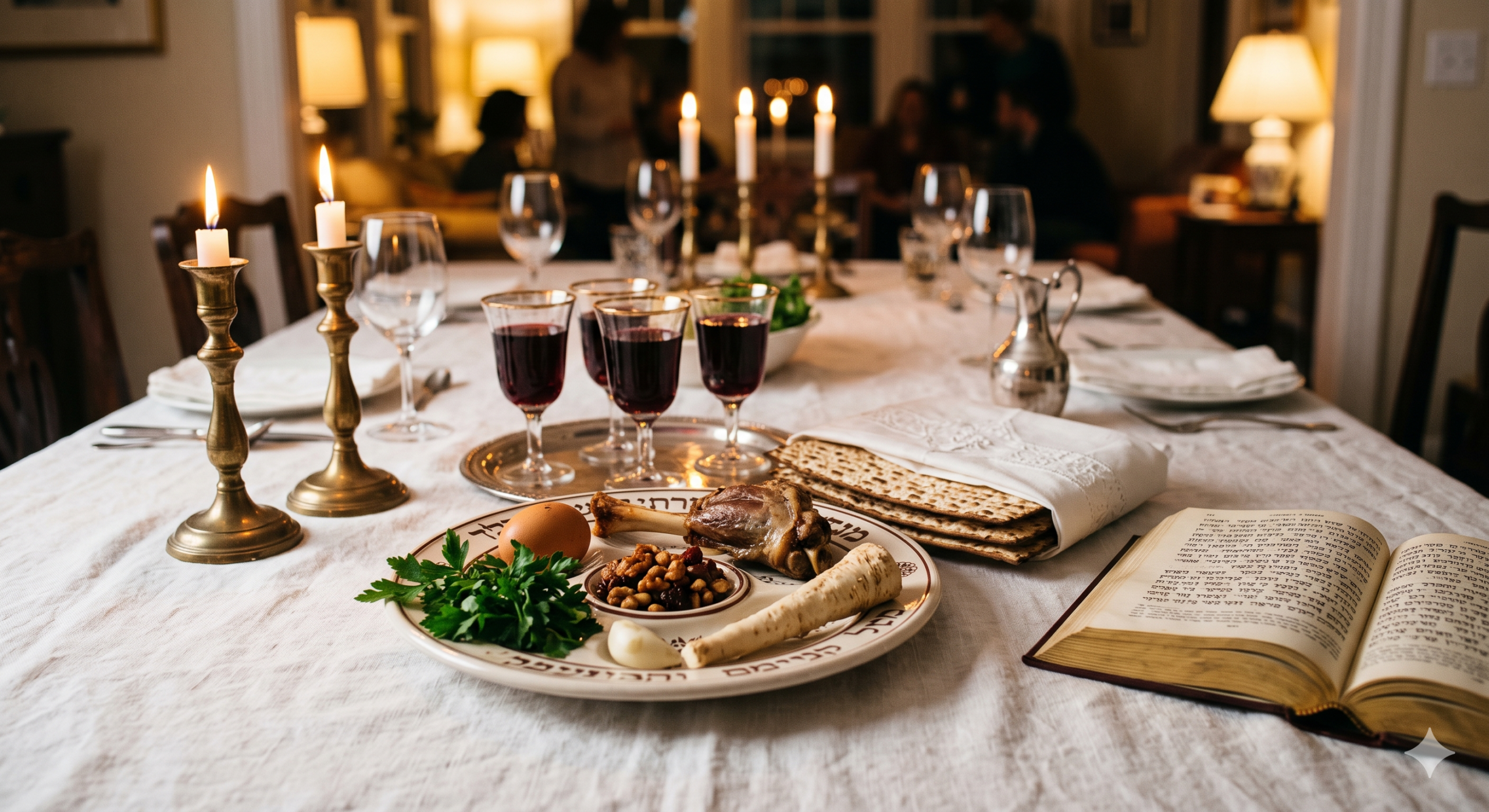
Over the centuries, the Jewish people developed the Passover Seder — a structured meal that retells the story of the Exodus through prayers, songs, symbolic foods, and Scripture readings. The word “Seder” means “order,” and every element of the meal follows a specific sequence passed down through generations.
For Messianic believers, the Seder is not just a memorial of what God did in Egypt — it is a prophetic picture of what He would do through Yeshua. Let’s look at some of the key elements.
The Passover Lamb
In the original Passover, salvation came through the blood of an unblemished lamb. The lamb had to be perfect — without spot or blemish. It was examined for four days to ensure it was flawless before it was sacrificed.
Yeshua entered Jerusalem on the 10th of Nisan — the same day the Passover lamb was selected. For the next four days, He was questioned, tested, and examined by the Pharisees, Sadducees, and Roman authorities. They found no fault in Him. And on the 14th of Nisan, at the very hour the Passover lambs were being slaughtered in the Temple, Yeshua — the Lamb of God — gave His life on the cross.
“The next day John saw Yeshua coming toward him and said, ‘Look, the Lamb of God, who takes away the sin of the world!'”
— John 1:29
The Apostle Paul made the connection explicit:
“For Messiah, our Passover lamb, has been sacrificed.”
— 1 Corinthians 5:7
The Matzah (Unleavened Bread)
During the Seder, three pieces of matzah are placed together in a special bag or cloth called a matzah tash. The middle piece is taken out, broken in half, wrapped in a white linen cloth, and hidden away. This hidden piece is called the afikomen — a Greek word meaning “that which comes after” or “the one who comes.”
Later in the meal, the children search for the afikomen. When it is found, it is brought back, unwrapped, and shared among everyone at the table.
Consider what happens to the afikomen:
- It is taken from the middle of three — as Yeshua, the Son, is the second person of the triune God
- It is broken — as Yeshua’s body was broken for us
- It is wrapped in white linen — as Yeshua’s body was wrapped in burial cloths
- It is hidden away — as Yeshua was buried in a tomb
- It is found and brought back — as Yeshua rose from the dead
Look at the matzah itself. It is unleavened (without sin), pierced, and striped — just as the prophet Isaiah wrote:
“He was pierced for our transgressions, He was crushed for our iniquities; the punishment that brought us peace was on Him, and by His stripes we are healed.”
— Isaiah 53:5
At the Last Supper — which was a Passover Seder — Yeshua took the bread, broke it, and said:
“This is My body given for you; do this in remembrance of Me.”
— Luke 22:19
The Four Cups
The traditional Passover Seder includes four cups of wine, each one tied to one of God’s four promises of redemption in Exodus 6:6–7:
- The Cup of Sanctification (Kiddush) — “I will bring you out from under the burdens of the Egyptians”
- The Cup of Deliverance (Makkot) — “I will rescue you from their bondage”
- The Cup of Redemption (Geulah) — “I will redeem you with an outstretched arm”
- The Cup of Praise (Hallel) — “I will take you as My people, and I will be your God”
It was the third cup — the Cup of Redemption — that Yeshua lifted at the Last Supper when He said:
“This cup is the new covenant in My blood, which is poured out for you.”
— Luke 22:20
The cup that represents redemption with an outstretched arm. And on the cross, Yeshua stretched out His arms and redeemed us — not from Egypt, but from sin and death itself.
There is also a fifth cup on the Seder table that no one drinks — the Cup of Elijah. It sits untouched, waiting for the prophet Elijah to come and announce the arrival of Messiah. A door is even opened during the Seder to welcome him. For those of us who follow Yeshua, this cup carries a profound meaning: Elijah did come — in the person of John the Immerser (Matthew 11:14) — and he announced the Messiah. The cup is fulfilled.
The Bitter Herbs and Charoset
The maror (bitter herbs, usually horseradish) represents the bitterness of slavery in Egypt. We taste it and remember the suffering of our ancestors — and, as believers, the suffering of Messiah who bore our sorrows.
The charoset — a sweet mixture of apples, nuts, honey, and wine — represents the mortar used by the Israelite slaves to make bricks. But its sweetness reminds us that even in suffering, redemption is coming. In Yeshua, the bitterness of sin is swallowed up by the sweetness of grace.
The Lamb Bone and the Egg
A roasted lamb shank bone (zeroa) sits on the Seder plate as a reminder of the Passover sacrifice. Since the destruction of the Temple in 70 AD, no Passover lamb has been sacrificed. The bone remains on the plate — a silent witness to a sacrifice that is missing. For Messianic believers, this is no accident. The final Passover Lamb has already been offered. Yeshua fulfilled what the Temple sacrifices pointed to.
A roasted egg (beitzah) represents the festival offering brought to the Temple. It also symbolizes mourning and new life — a fitting symbol of the resurrection.
Why Messianic Jews Still Celebrate Passover
Some people ask: if Yeshua fulfilled Passover, why do you still celebrate it?
The answer is simple — because He told us to.
“Do this in remembrance of Me.”
— Luke 22:19
Yeshua did not abolish Passover. He filled it with meaning. When we celebrate the Seder, we are not looking backward only — we are looking at what God has done, what He is doing, and what He has promised to do when Messiah returns.
Here is why we continue to keep this feast:
1. God Called It a Lasting Ordinance
Passover was not given as a temporary observance. God commanded it as l’dorot — “for your generations” — a lasting ordinance (Exodus 12:14). The feasts of the LORD belong to Him, not to a dispensation. They are His appointed times, and they remain on His calendar.
2. Yeshua Himself Observed It
Yeshua kept Passover. The Last Supper was a Passover Seder. He did not replace it with something new — He revealed what it had always been pointing to. When we celebrate Passover, we are doing what Yeshua did, at the table where He sat, with the words He spoke.
3. It Tells the Gospel in Full Color
There is no better teaching tool for the gospel than the Passover Seder. The lamb, the blood on the doorposts, the unleavened bread, the cups of redemption — every element tells the story of Yeshua. When we share a Seder together, believers and seekers alike encounter the gospel not as an abstract idea but as a living, tangible experience around a table.
4. It Connects Us to the Whole Story of Scripture
The Bible is one story — not two separate books for two separate peoples. Passover connects the Exodus to the Cross to the coming Kingdom. It reminds us that the God who delivered Israel from Egypt is the same God who delivered us from sin through His Son. The thread runs from Genesis to Revelation, and Passover is one of the brightest threads in the tapestry.
5. It Brings Jewish and Gentile Believers Together
At Kehilat Ben David, one of the most beautiful things about our Passover celebration is that Jewish and Gentile believers sit at the same table, share the same bread, drink from the same cup, and tell the same story. This is the “one new man” that Paul describes in Ephesians 2:14–15 — not erasing our distinctions, but uniting us in Messiah around a shared inheritance.
What Passover Looks Like at Kehilat Ben David
Each year, our congregation gathers for a community Passover Seder. It is one of the highlights of our year — a time when we slow down, gather as a family, and walk through the story of redemption together.
Here’s what you can expect:
- A full Seder meal — with all the traditional elements: matzah, maror, charoset, the four cups, and more
- Messianic teaching — we walk through each element and show how it connects to Yeshua
- Worship and prayer — in Hebrew and English, including traditional Passover songs like Dayenu (“It Would Have Been Enough”)
- Community and fellowship — a shared meal around the table, just as the first Passover was eaten together by families and neighbors
- A welcoming atmosphere — whether you’ve celebrated Passover your whole life or have never attended a Seder, you are welcome. We explain everything as we go
You do not need to be Jewish. You do not need to know Hebrew. You do not need to bring anything except yourself and a willingness to encounter God in His Word.
The Passover That Is Coming
There is one more reason we celebrate Passover — and it may be the most important one.
At the Last Supper, after lifting the cup, Yeshua said:
“I tell you, I will not drink from this fruit of the vine from now on until that day when I drink it new with you in My Father’s kingdom.”
— Matthew 26:29
There is a Passover still to come. A table still to be set. A cup still to be shared. When Messiah returns, He will sit down with His people and celebrate the feast in its fullness — the ultimate deliverance, the final redemption, the great homecoming.
Every time we lift the cup and break the bread, we are not only remembering what He did — we are declaring that He is coming again.
Join Us
If you’ve never experienced a Messianic Passover Seder, we would love to have you at our table. And if Passover has sparked a deeper curiosity about the Jewish roots of your faith, we invite you to join us any Shabbat.
We meet every 1st and 3rd Saturday at 12:30 PM at Calvary Baptist Church in Oceanport, NJ. Come as you are.
Questions? Email us at info@kahilatbendavid.org or visit our Contact page.
Chag Pesach Sameach — Happy Passover!