“Blow the trumpet in Zion; sound the alarm on My holy hill.” — Joel 2:1
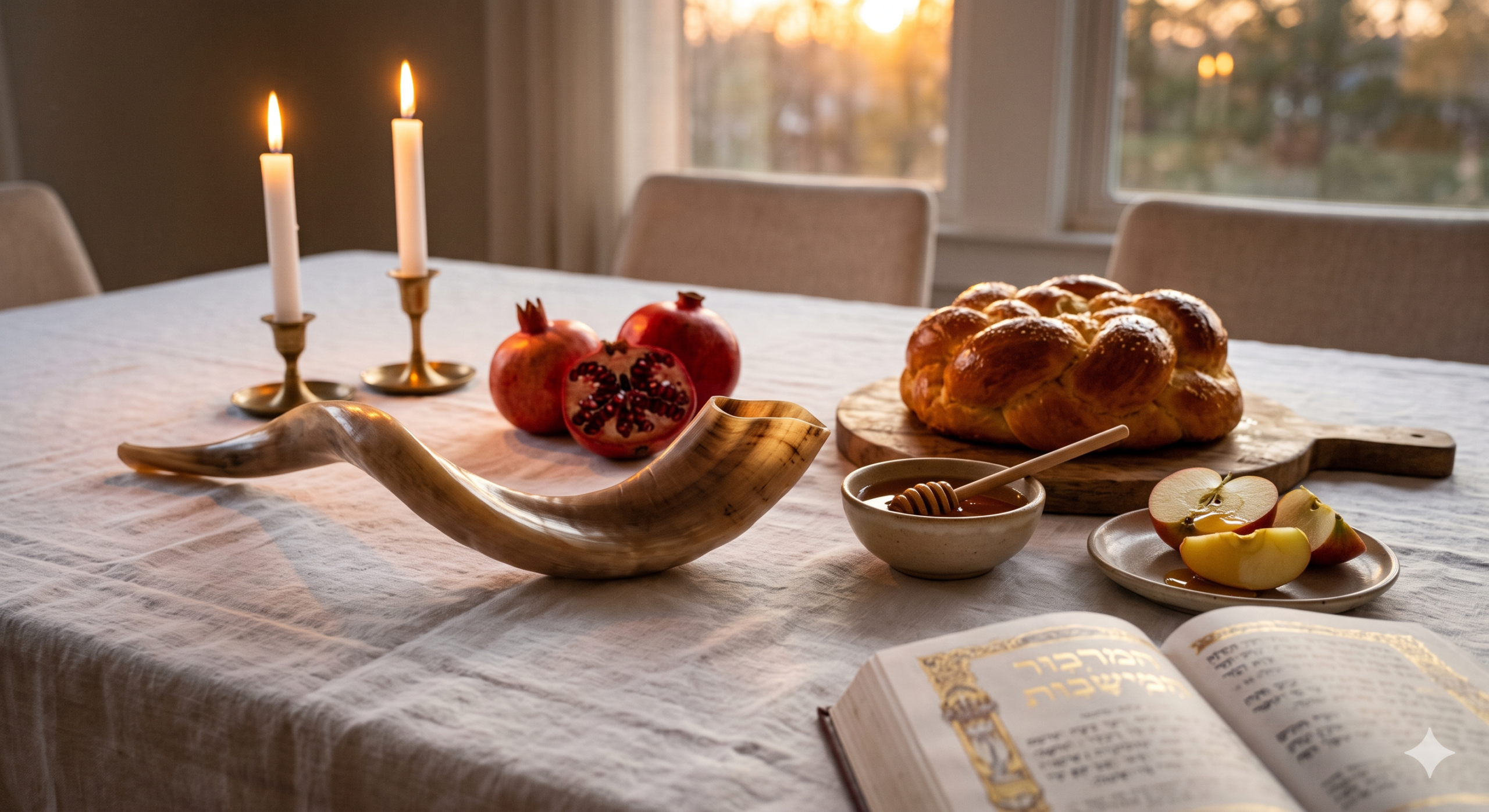
Every year, on the first day of the seventh month of the biblical calendar, a sound cuts through the air that has echoed across thousands of years of Jewish history — the piercing cry of the shofar, the ram’s horn.
This is Rosh Hashanah. The Jewish New Year. The head of the year. But long before it carried that name, God called it something else — Yom Teruah, the Day of Trumpets, the Day of the Awakening Blast. And for those of us who believe Yeshua is the Messiah, this feast is not just a look backward. It is a prophetic alarm clock pointing to the most dramatic event still to come — the return of the King.
The Biblical Command: A Day of Trumpet Blasts
Unlike Passover and Shavuot, which are rich with historical narrative, the biblical command for this feast is remarkably brief — and remarkably mysterious:
“The LORD said to Moses, ‘Say to the Israelites: On the first day of the seventh month you are to have a day of sabbath rest, a sacred assembly commemorated with trumpet blasts. Do no regular work, but present a food offering to the LORD.'”
— Leviticus 23:23–25
That’s it. No explanation of what the trumpets are for. No story attached. No historical event to commemorate. God simply says: on this day, blow the trumpet. Rest. Assemble. Listen.
This makes Yom Teruah unique among the appointed times. Passover remembers the Exodus. Shavuot remembers the giving of the Torah. Sukkot remembers the wilderness journey. But the Feast of Trumpets has no past event — it points entirely forward. It is the one feast that is still waiting for its ultimate fulfillment.
And that is what makes it so extraordinary.
The Shofar: More Than a Horn
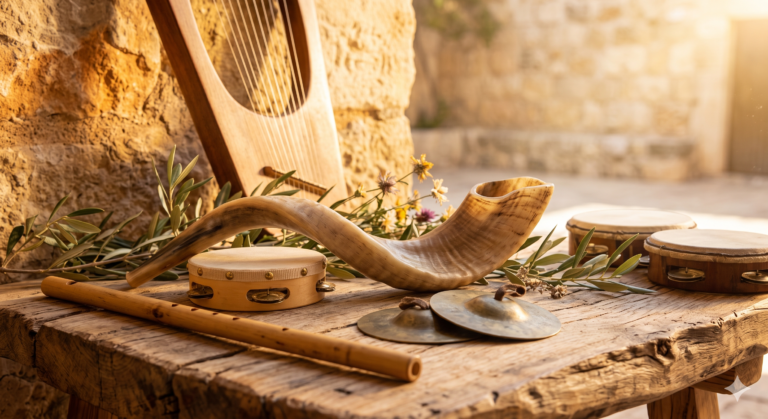
The shofar is not a musical instrument. It is a voice. In Jewish tradition, the sound of the shofar is the wordless cry of the soul — a sound that bypasses language and speaks directly to the heart.
Throughout Scripture, the shofar appears at pivotal moments:
- At Mount Sinai, a shofar blast grew louder and louder as God descended in fire to give the Torah (Exodus 19:16, 19)
- At Jericho, the walls fell when the priests blew the shofars and the people shouted (Joshua 6:20)
- In battle, the shofar sounded the alarm, rallied the troops, and announced the presence of the King (Judges 3:27; 2 Samuel 6:15)
- At coronations, the shofar proclaimed the crowning of a new king over Israel (1 Kings 1:34, 39)
- On the Day of Atonement in the Jubilee year, the shofar announced freedom — every debt cancelled, every slave set free, every family restored to their land (Leviticus 25:9–10)
The shofar is the sound of God showing up. It announces His presence, His authority, His kingship, and His deliverance. When the shofar sounds, something is about to change.
The Traditional Shofar Blasts
On Rosh Hashanah, the shofar is blown in a specific sequence of sounds, traditionally totaling one hundred blasts over the course of the service. The three primary sounds are:
- Tekiah — one long, clear blast. The sound of proclamation and the voice of the King. It declares: God reigns.
- Shevarim — three medium, broken blasts. The sound of weeping and brokenness. It echoes the groan of a heart crying out to God.
- Teruah — nine short, rapid blasts. The sound of alarm and urgency. Wake up. Pay attention. Something is coming.
And then, at the very end, comes a blast unlike the others:
Tekiah Gedolah — the Great Tekiah. One single blast, held as long as the breath allows. It is the longest, loudest, most sustained sound of the entire service. It is the last trumpet.
The last trumpet.
If that phrase sounds familiar, it should.
The Last Trumpet: Rosh Hashanah and the Return of Messiah
For Messianic believers, the Tekiah Gedolah — the last trumpet of Rosh Hashanah — carries a weight that goes far beyond tradition. It connects directly to some of the most important prophecies in the New Covenant.
Paul wrote to the believers in Corinth:
“Listen, I tell you a mystery: We will not all sleep, but we will all be changed — in a flash, in the twinkling of an eye, at the last trumpet. For the trumpet will sound, the dead will be raised imperishable, and we will be changed.”
— 1 Corinthians 15:51–52
And to the Thessalonians:
“For the Lord Himself will come down from heaven, with a loud command, with the voice of the archangel and with the trumpet call of God, and the dead in Messiah will rise first.”
— 1 Thessalonians 4:16
A trumpet. A shout. The dead rising. The living transformed. The King arriving.
Paul was a Jewish man writing to communities that understood the biblical feasts. When he said “the last trumpet,” his readers would not have thought of a random horn blast. They would have thought of Rosh Hashanah — the Feast of Trumpets — and the Tekiah Gedolah, the final blast that closes the shofar service.
Yeshua Himself described His return in language that echoes the Feast of Trumpets:
“At that time the sign of the Son of Man will appear in the sky, and all the peoples of the earth will mourn. They will see the Son of Man coming on the clouds of heaven, with power and great glory. And He will send His angels with a great trumpet call, and they will gather His elect from the four winds, from one end of the heavens to the other.”
— Matthew 24:30–31
A great trumpet call. The gathering of the elect. The Son of Man appearing in glory.
Every appointed time in Leviticus 23 has been fulfilled — or is being fulfilled — by Yeshua. He was crucified on Passover. He was buried during Unleavened Bread. He rose on Firstfruits. He sent the Spirit on Shavuot. The spring feasts have all been fulfilled in His first coming.
The fall feasts — beginning with the Feast of Trumpets — point to His second coming. And they have not yet been fulfilled.
When the shofar sounds on Rosh Hashanah, we are rehearsing the moment when the sky will split open and the King will return.
The Day No One Knows
There is another fascinating connection. Yeshua told His disciples:
“But about that day or hour no one knows, not even the angels in heaven, nor the Son, but only the Father.”
— Matthew 24:36
Many people read this as a statement of total mystery — we can never know anything about the timing of His return. But in Jewish culture, the phrase “the day no one knows” is actually a well-known idiom for a specific day: Rosh Hashanah.
Here’s why. Rosh Hashanah is the only feast that falls on the first day of a new month — the new moon. In ancient Israel, the new month was not determined by a pre-set calendar. It began when two witnesses in Jerusalem physically spotted the first sliver of the new moon and reported it to the Sanhedrin. Until those witnesses came forward, no one could officially declare the start of the month.
So while every other feast had a fixed date you could count to, Rosh Hashanah was always uncertain by a day or two. It was, quite literally, the day and hour that no one knew.
When Yeshua used that phrase, He was not discouraging His followers from understanding the times. He was dropping a hint — pointing them to the Feast of Trumpets, the appointed time that pictures His return.
Rosh Hashanah: The Coronation of the King
In Jewish tradition, Rosh Hashanah is also known as the coronation day of God as King over all creation. The central theme of the synagogue liturgy on this day is Malchuyot — Kingship. The prayers declare again and again: God is King. God reigns. God will reign forever.
The shofar at a coronation is not background music — it is the official announcement that the King has taken His throne. When Solomon was crowned king, the shofar sounded and the people shouted, “Long live the King!” (1 Kings 1:34, 39).
For Messianic believers, this carries tremendous prophetic weight. Yeshua came the first time as the Suffering Servant described in Isaiah 53 — humble, rejected, sacrificed. But He is returning as the King described in Revelation 19 — riding on a white horse, wearing many crowns, with a name written on His robe: King of Kings and Lord of Lords.
The Feast of Trumpets is a rehearsal for that coronation. When we sound the shofar, we are declaring what we believe is coming: Yeshua, the Son of David, will take His rightful throne. Every knee will bow and every tongue will confess that He is Lord (Philippians 2:10–11).
“The seventh angel sounded his trumpet, and there were loud voices in heaven, which said: ‘The kingdom of the world has become the kingdom of our Lord and of His Messiah, and He will reign for ever and ever.'”
— Revelation 11:15
Teshuvah: The Call to Return
Rosh Hashanah also marks the beginning of the Yamim Noraim — the Days of Awe — a ten-day period of repentance and self-examination that leads up to Yom Kippur, the Day of Atonement.
The Hebrew word for repentance is teshuvah, and it means more than feeling sorry. It means to turn — to turn around, to return to God, to come home. Jewish tradition teaches that during the Days of Awe, the books of heaven are open. God examines the hearts of His people. And the shofar blast on Rosh Hashanah is the alarm that says: wake up. Examine your life. Return to God before the books are closed on Yom Kippur.
The great medieval rabbi Maimonides wrote that the shofar is saying: “Awake, you sleepers, from your sleep! Rouse yourselves, you slumberers, from your slumber! Examine your deeds, return in repentance, and remember your Creator.”
Even for those of us who rest in the finished work of Yeshua and know that our salvation is secure by grace through faith, the call to teshuvah is still vital. Not because our standing before God is in question, but because our hearts can drift. We can grow comfortable. We can fall asleep spiritually. The shofar cuts through the noise and says: come back. Draw near. Remember who you are and whose you are.
Paul echoed this urgency:
“The hour has already come for you to wake up from your slumber, because our salvation is nearer now than when we first believed.”
— Romans 13:11
The Book of Life
On Rosh Hashanah, the traditional Jewish greeting is L’shanah tovah tikateivu — “May you be inscribed for a good year.” This reflects the belief that on Rosh Hashanah, God opens the Book of Life and begins to write the destiny of each person for the coming year.
The concept of a heavenly book is deeply biblical:
- Moses pleaded with God: “If You will not forgive their sin, then blot me out of the book You have written” (Exodus 32:32)
- David wrote: “All the days ordained for me were written in Your book before one of them came to be” (Psalm 139:16)
- Daniel prophesied: “At that time your people — everyone whose name is found written in the book — will be delivered” (Daniel 12:1)
- Yeshua told His disciples: “Rejoice that your names are written in heaven” (Luke 10:20)
- John wrote: “Anyone whose name was not found written in the book of life was thrown into the lake of fire” (Revelation 20:15)
For Messianic believers, the Book of Life is not an abstract concept — it is a reality secured by the blood of the Lamb. Our names are written there not because of our merit but because of His sacrifice. And yet the imagery of Rosh Hashanah reminds us of the weight of that truth. Names are being written. Destinies are being sealed. And one day the books will be opened for the final time.
What Rosh Hashanah Looks Like at Kehilat Ben David
Rosh Hashanah is one of the most powerful services of our year. There is nothing quite like standing in a room full of believers — Jewish and Gentile together — as the shofar sounds and the declaration goes up: the King is coming.
Here’s what you can expect when you celebrate with us:
- The sounding of the shofar — the ancient blasts of Tekiah, Shevarim, Teruah, and the great Tekiah Gedolah
- Teaching — we explore the biblical meaning of the Feast of Trumpets and its prophetic connection to the return of Yeshua
- Worship — Messianic praise in Hebrew and English, declaring the kingship of God and the lordship of Yeshua
- Teshuvah and prayer — a time of reflection, repentance, and drawing near to God as the Days of Awe begin
- Traditional foods — apples dipped in honey (for a sweet new year), round challah bread (symbolizing the cycle of the year and God’s unending faithfulness), and pomegranates (tradition says they contain 613 seeds, one for each commandment)
- Community meal — as always, we gather at the table to eat and celebrate together
The traditional Rosh Hashanah greeting is Shanah Tovah — “A good year.” And among believers we add: Shanah Tovah u’Metukah — “A good and sweet year.”
The Trumpet Will Sound
We live between two trumpet blasts.
The first shofar sounded at Sinai, when God came down in fire and established His covenant with Israel. The last shofar will sound when Yeshua returns in glory to establish His kingdom on earth.
Every Rosh Hashanah, when we lift the shofar to our lips, we are standing in that space between — remembering what God has done, celebrating what He is doing, and longing for what He has promised to do. We are rehearsing the greatest event in human history, an event that has not yet happened but is as certain as every prophecy that has already been fulfilled.
The Lamb who was slain at Passover is the King who will be crowned at the Feast of Trumpets.
“For the Lord Himself will come down from heaven, with a loud command, with the voice of the archangel and with the trumpet call of God.”
— 1 Thessalonians 4:16
The trumpet will sound. And everything will change.
Join Us
If you have never heard the shofar blown in worship, or if you’ve celebrated the Jewish New Year but never seen it through the lens of Messiah, we would love to have you with us for Rosh Hashanah. And if this feast has stirred something in you — a longing, a curiosity, a sense that there is more to the story — we invite you to join us any Shabbat.
We meet every 1st and 3rd Saturday at 12:30 PM at Calvary Baptist Church in Oceanport, NJ. Come as you are.
Questions? Email us at info@kahilatbendavid.org or visit our Contact page.
Shanah Tovah u’Metukah — A good and sweet year!