“When the day of Pentecost came, they were all together in one place.” — Acts 2:1
Most people know the story of Pentecost — the sound of a rushing wind, tongues of fire, and the Holy Spirit descending on the disciples in Jerusalem. But what many don’t realize is that Pentecost didn’t begin in the book of Acts. It began at Mount Sinai, over a thousand years earlier.
The event in Acts 2 took place on Shavuot — the biblical Feast of Weeks — one of God’s appointed times commanded in Leviticus 23. And when you understand what Shavuot has always been about, the outpouring of the Spirit stops being a surprise. It becomes the fulfillment of a promise God made from the very beginning.
What Is Shavuot?
Shavuot (shah-voo-OAT) is a Hebrew word meaning “weeks.” It is one of the three pilgrimage festivals — along with Passover and Sukkot — when all of Israel was commanded to appear before the LORD in Jerusalem (Deuteronomy 16:16).
God gave specific instructions for counting to this feast:
“From the day after the Sabbath, the day you brought the sheaf of the wave offering, count off seven full weeks. Count off fifty days up to the day after the seventh Sabbath, and then present an offering of new grain to the LORD.”
— Leviticus 23:15–16
Seven weeks — forty-nine days — after the offering of the firstfruits during Passover, on the fiftieth day, the people of Israel celebrated Shavuot. This is why the Greek name for the feast is Pentecost, from the word pentekostos, meaning “fiftieth.”
On the surface, Shavuot was an agricultural festival — the celebration of the wheat harvest and the offering of the firstfruits. But Jewish tradition has always understood it as something far more significant.
Shavuot is the anniversary of the giving of the Torah at Mount Sinai.
Sinai: The First Shavuot
After God delivered Israel from Egypt at Passover, He led them through the wilderness to the foot of Mount Sinai. According to Exodus 19, they arrived in the third month — and Jewish tradition places the giving of the Torah on the sixth of Sivan, exactly fifty days after the Exodus. The timing is Shavuot.
What happened at Sinai was unlike anything the world had ever seen:
“On the morning of the third day there was thunder and lightning, with a thick cloud over the mountain, and a very loud trumpet blast. Everyone in the camp trembled… Mount Sinai was covered with smoke, because the LORD descended on it in fire.”
— Exodus 19:16, 18
God Himself came down. He spoke the Ten Commandments aloud in the hearing of the entire nation. And then He gave Moses the Torah — the teaching, the instruction, the covenant — written by His own finger on tablets of stone.
This was the moment when Israel became a nation set apart. God had redeemed them at Passover. Now, at Shavuot, He gave them His Word — the terms of the covenant, the blueprint for how to live as His people.
But something went wrong.
While Moses was on the mountain, the people grew impatient and built a golden calf. When Moses came down and saw what they had done, the Levites were called to execute judgment. That day, three thousand people died (Exodus 32:28).
The Torah was given — but the people could not keep it. The law was written on stone, but their hearts were still hard.
God knew this. And He made a promise:
“I will put My law in their minds and write it on their hearts. I will be their God, and they will be My people.”
— Jeremiah 31:33
Shavuot at Sinai was not the end of the story. It was a prophecy waiting to be fulfilled.
Pentecost: The Fulfillment
Fast forward over a thousand years. Yeshua has been crucified at Passover, raised from the dead, and has spent forty days with His disciples after the resurrection. Before ascending to heaven, He gives them one instruction:
“Do not leave Jerusalem, but wait for the gift My Father promised… you will receive power when the Holy Spirit comes on you.”
— Acts 1:4, 8
The disciples waited. And on the fiftieth day — on Shavuot — it happened:
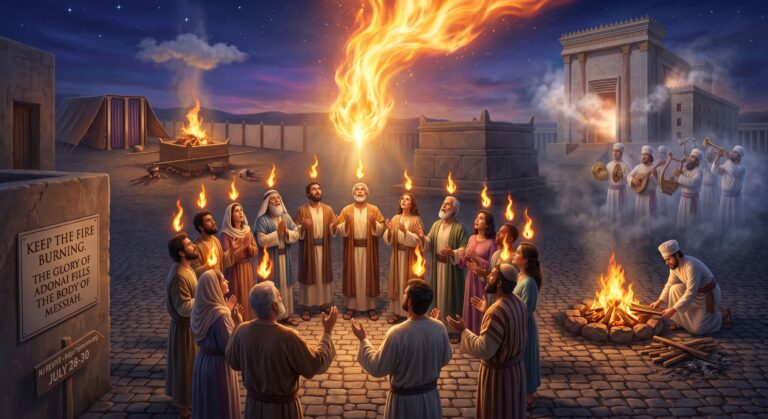
“Suddenly a sound like the blowing of a violent wind came from heaven and filled the whole house where they were sitting. They saw what seemed to be tongues of fire that separated and came to rest on each of them. All of them were filled with the Holy Spirit.”
— Acts 2:2–4
This was not a coincidence. God chose Shavuot — the very day the Torah was given at Sinai — to pour out His Spirit. And the parallels between the two events are staggering.
Sinai and Pentecost: Side by Side
When you lay these two Shavuot events next to each other, the pattern is unmistakable:
- At Sinai, God descended in fire on the mountain. At Pentecost, tongues of fire rested on each believer.
- At Sinai, God spoke in one voice that the whole nation heard. At Pentecost, the disciples spoke in many languages that people from every nation understood.
- At Sinai, the Torah was written on tablets of stone. At Pentecost, the Spirit wrote God’s law on human hearts — fulfilling Jeremiah 31:33.
- At Sinai, three thousand died because of the golden calf. At Pentecost, three thousand were saved and added to the community of believers (Acts 2:41).
- At Sinai, Israel became a nation under the covenant. At Pentecost, the body of Messiah — the kehilah — was born.
The letter kills, but the Spirit gives life (2 Corinthians 3:6). What the law written on stone could not accomplish because of human weakness, God accomplished by putting His Spirit within us.
Shavuot was always leading here.
Ruth: A Shavuot Story
There is a beautiful Jewish tradition of reading the book of Ruth on Shavuot. At first glance, it seems like an unusual choice — a love story read on the anniversary of receiving the Torah. But the connections run deep.
Ruth was a Moabitess — a Gentile woman — who chose to leave everything she knew and follow Naomi back to Israel. Her famous words echo the heart of every believer who has been grafted into the commonwealth of Israel:
“Where you go I will go, and where you stay I will stay. Your people will be my people and your God my God.”
— Ruth 1:16
Ruth came to Israel during the wheat harvest — the time of Shavuot. She gleaned in the fields of Boaz, who became her kinsman-redeemer — a man who had the right to redeem her, restore her, and bring her into the family.
For Messianic believers, the parallels are breathtaking:
- Ruth the Gentile chose to follow the God of Israel — just as Gentile believers are grafted into the olive tree of Israel through faith in Yeshua (Romans 11:17)
- Boaz the kinsman-redeemer pictures Yeshua — our Redeemer who had the right and the willingness to pay the price for us
- The harvest setting connects to Shavuot’s identity as the feast of firstfruits — and in Acts 2, the three thousand who came to faith were the firstfruits of a harvest that is still being gathered today
- Ruth’s line produced King David — and from the line of David came Yeshua, the Son of David and Messiah of Israel
Ruth’s story is a Shavuot story because Shavuot has always been about more than Israel alone. It is about a God who extends His covenant, His Spirit, and His love to all nations — to everyone willing to say, “Your people will be my people, and your God my God.”
At Kehilat Ben David, we know this truth personally. We are a congregation of both Jewish and Gentile believers — modern-day Ruths and Boazes sitting at the same table, gathered under the same covenant, filled with the same Spirit.
The Firstfruits of a Greater Harvest
Shavuot is called the feast of firstfruits — and that word carries prophetic weight.
The firstfruits are not the whole harvest. They are the first portion, offered to God as a promise that the full harvest is coming. When the three thousand came to faith at Pentecost, they were the firstfruits of a harvest that has continued for two thousand years and is still being gathered.
Paul uses this same language when he writes about the resurrection:
“But Messiah has indeed been raised from the dead, the firstfruits of those who have fallen asleep.”
— 1 Corinthians 15:20
Yeshua’s resurrection was the firstfruit. Our resurrection is the harvest. And the Spirit given at Shavuot is the guarantee — the down payment — of everything that is still to come:
“Having believed, you were marked in Him with a seal, the promised Holy Spirit, who is a deposit guaranteeing our inheritance.”
— Ephesians 1:13–14
Every time we celebrate Shavuot, we are declaring that the harvest is not finished. God is still drawing people — Jewish and Gentile — to Himself through His Spirit. The firstfruits have been offered. The full harvest is on its way.
Why We Celebrate Shavuot at Kehilat Ben David
For us, Shavuot is one of the most meaningful appointed times on the biblical calendar. It is where the Torah and the Spirit meet — where the old covenant and the new covenant shake hands — where we see that God’s plan has always been one continuous story of redemption.
Here is what our Shavuot celebration looks like:
- Teaching — We walk through the connections between Sinai and Pentecost, exploring how the giving of the Spirit fulfills what began with the giving of the Torah
- Reading the book of Ruth — Following the Jewish tradition, we read Ruth together and see our own story reflected in hers
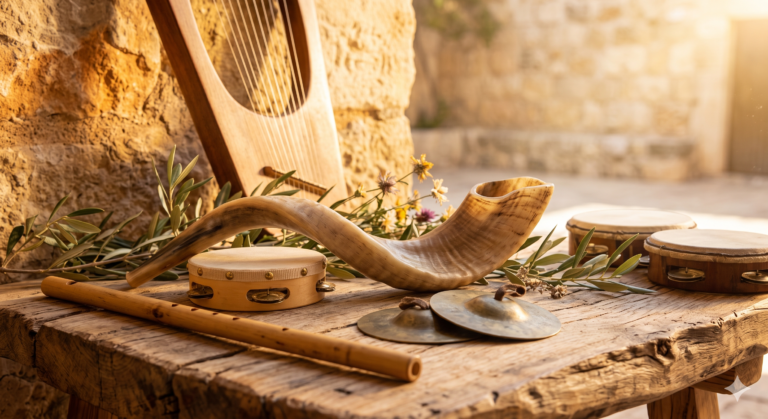
- Worship — Messianic praise in Hebrew and English, celebrating the God who writes His Word not on stone but on our hearts
- Prayer for the Spirit — We ask God to fill us afresh with His Spirit, just as He did on that first Pentecost in Jerusalem
- Community meal — As always, we gather around the table to eat, talk, and share life together
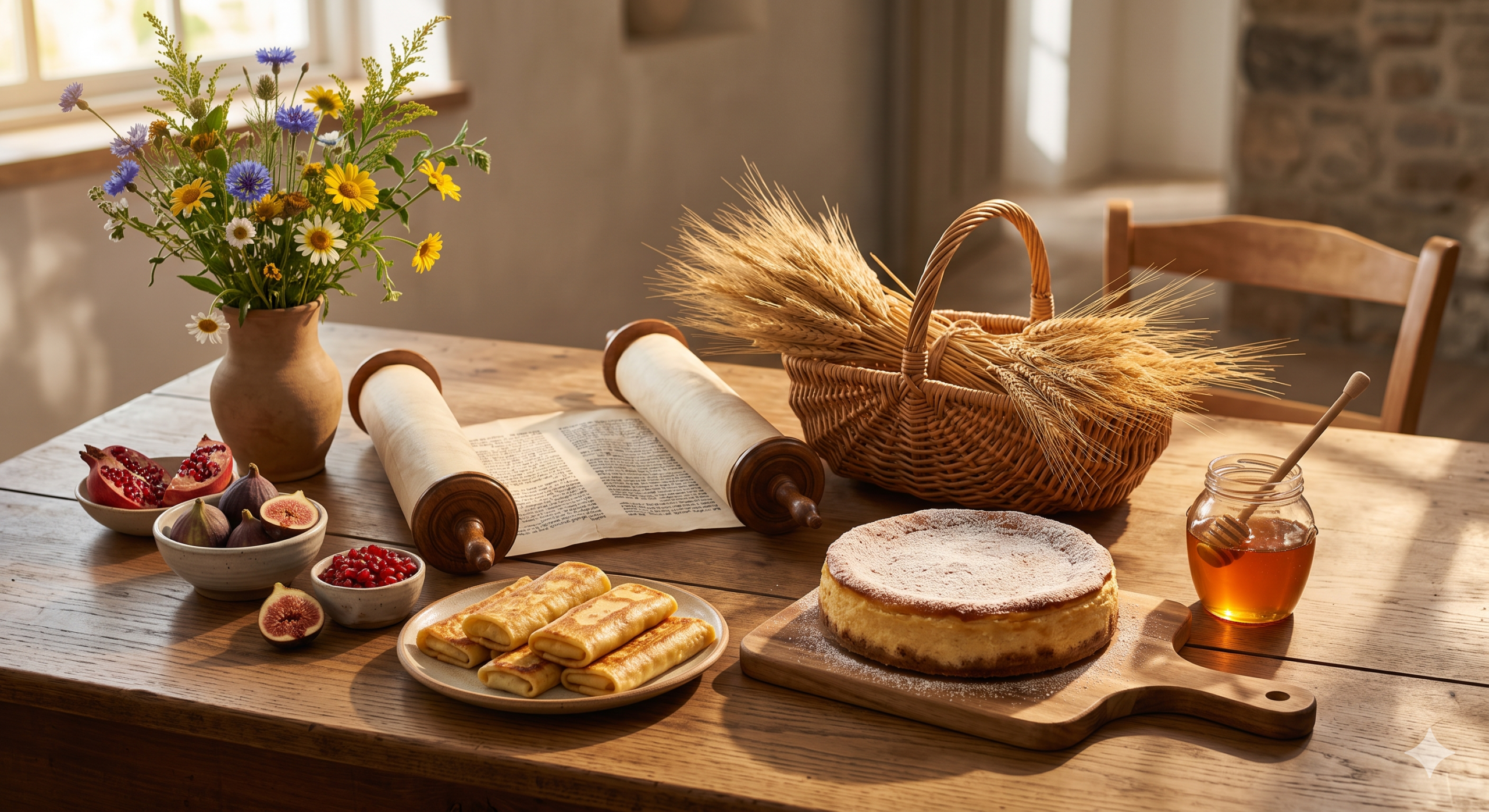
There is a Jewish tradition of eating dairy foods on Shavuot — cheesecake, blintzes, and other dairy dishes. One reason given is that the Torah is compared to milk and honey (Song of Songs 4:11). Another is that when Israel received the Torah and learned the dietary laws for the first time, they realized their pots and dishes were not kosher, so they ate dairy until they could prepare properly. Whatever the reason, it makes for a delicious celebration.
An Invitation
Shavuot reminds us that God has never been content to give us rules from a distance. He wants to dwell within us. The same God who descended in fire on Sinai descended in fire on the disciples at Pentecost — and He offers that same Spirit to everyone who calls on the name of Yeshua.
“The promise is for you and your children and for all who are far off — for all whom the Lord our God will call.”
— Acts 2:39
If you have never explored the Jewish roots of Pentecost, or if you’ve celebrated Pentecost in a church but never connected it to Shavuot, we invite you to come and experience it with us. And if the story of Ruth resonates with you — if you are a Gentile believer who has felt drawn to the God of Israel and the Jewish roots of your faith — know that you belong here. You are not a stranger. You have been grafted in.
We meet every 1st and 3rd Saturday at 12:30 PM at Calvary Baptist Church in Oceanport, NJ. Come as you are.
Questions? Email us at info@kahilatbendavid.org or visit our Contact page.
Chag Shavuot Sameach — Happy Feast of Weeks!