“For on this day atonement will be made for you, to cleanse you. Then, before the LORD, you will be clean from all your sins.” — Leviticus 16:30
There is one day on the biblical calendar that stands apart from all others. It is not a celebration. It is not a feast. It is the most solemn, most sacred, most awe-filled day of the year — the day when the fate of an entire nation hung on the actions of one man, in one room, offering one sacrifice.
This is Yom Kippur — the Day of Atonement.
For the Jewish people, Yom Kippur has been observed for over three thousand years. It is the climax of the High Holy Days, the closing of the Days of Awe that began on Rosh Hashanah. It is a day of fasting, prayer, and repentance — a day when the community comes together to stand before God and ask: will You forgive us? Will You seal us in the Book of Life for another year?
For Messianic believers, Yom Kippur is all of this — and something more. It is the day that reveals, more clearly than any other, what Yeshua accomplished on the cross. Every element of the ancient Yom Kippur service in the Temple is a portrait of the Messiah, painted a thousand years before He came.
The Biblical Command: The Holiest Day
God gave explicit and detailed instructions for this day — more detailed than for any other feast:
“This is to be a lasting ordinance for you: On the tenth day of the seventh month you must deny yourselves and not do any work — whether native-born or a foreigner residing among you — because on this day atonement will be made for you, to cleanse you. Then, before the LORD, you will be clean from all your sins. It is a day of sabbath rest, and you must deny yourselves; it is a lasting ordinance.”
— Leviticus 16:29–31
Yom Kippur falls on the tenth of Tishrei — ten days after Rosh Hashanah. It is the only fast day commanded in the Torah. The phrase “deny yourselves” (anah nefesh) refers to fasting and abstaining from physical comforts. For twenty-five hours, from sundown to sundown, the people of Israel set aside food, drink, and the routines of ordinary life to focus entirely on one thing: atonement.
The Hebrew word for atonement is kaphar, and it means to cover. On Yom Kippur, the sins of the nation were covered — not removed permanently, but covered for another year. It was a temporary solution to a permanent problem. And God designed it that way on purpose — because the real solution was coming.
The High Priest: One Man, One Day, One Room
The heart of Yom Kippur was a ritual performed by one person: the Kohen Gadol — the High Priest. On this one day each year, and only on this day, the High Priest was permitted to enter the Holy of Holies — the innermost chamber of the Tabernacle (and later the Temple), where the Ark of the Covenant sat and where the very presence of God dwelled.
No other person could enter. No other day would do. If the High Priest entered unworthily, he would die in the presence of God. Jewish tradition tells us that a rope was tied to the High Priest’s ankle so that if he died inside, his body could be pulled out — because no one else was allowed to go in after him.
The preparation was intense. For seven days before Yom Kippur, the High Priest was separated from his family and his normal life. He studied the rituals. He was sprinkled with purification water. He rehearsed every step. Everything had to be done exactly right.
On the morning of Yom Kippur, the High Priest removed his ornate, gold-embroidered garments — the breastplate with the twelve stones representing the tribes of Israel, the turban with the golden plate reading “Holy to the LORD,” the blue robe with golden bells. He set it all aside.
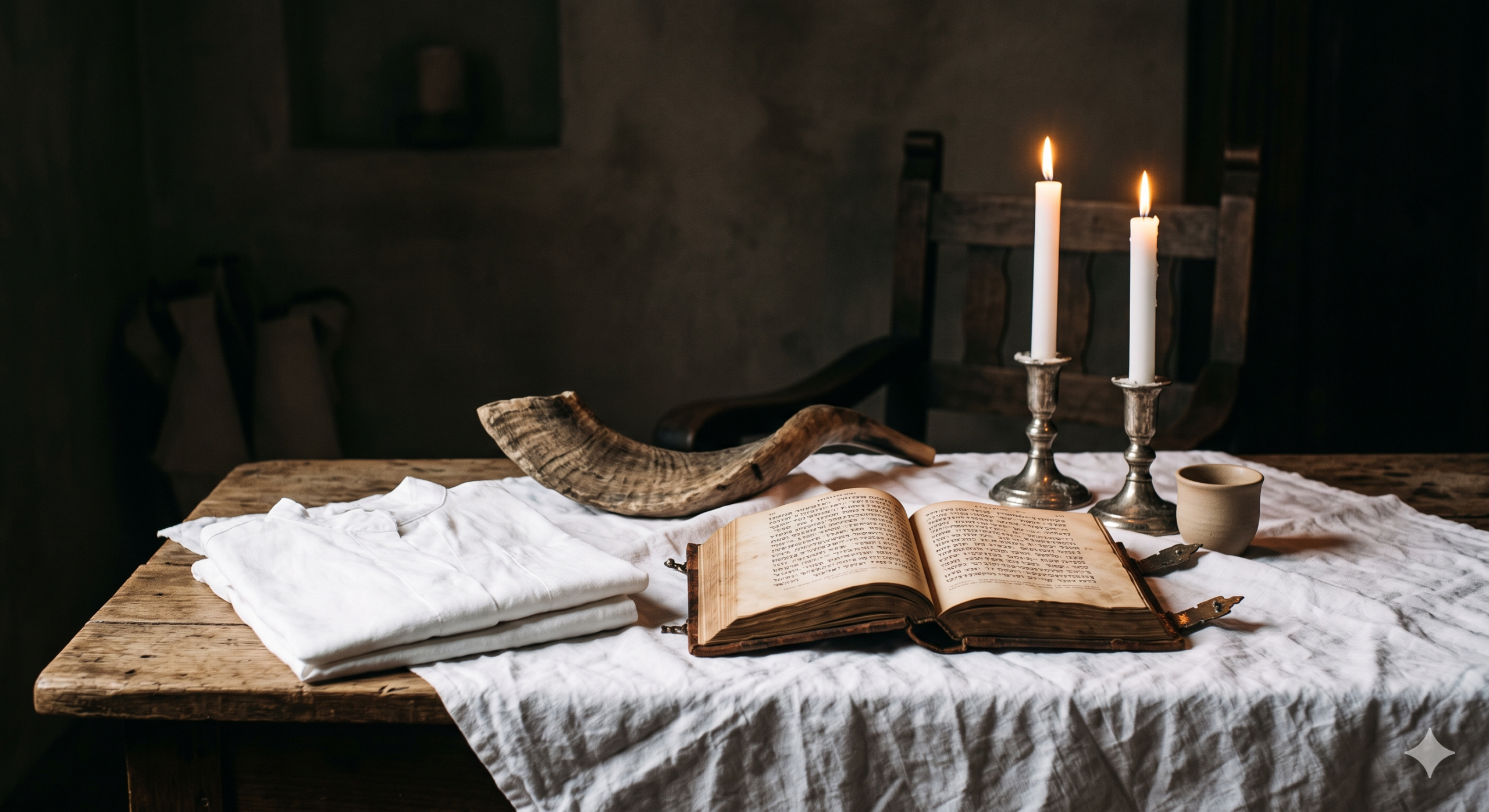
Instead, he put on simple white linen garments — a plain tunic, plain trousers, a plain sash, a plain turban. No gold. No jewels. No marks of office. Just white linen.
The High Priest entered the Holy of Holies not in glory, but in humility.
The Two Goats: A Picture of the Messiah
The central ritual of Yom Kippur involved two goats. Two animals, but one purpose — and together they paint one of the most vivid prophetic portraits of Yeshua in all of Scripture.
The Lot Was Cast
Two male goats, identical in appearance and value, were brought before the High Priest at the entrance to the Tabernacle. The priest cast lots over them — one lot marked “For the LORD” and one marked “For Azazel” (the scapegoat). The goats did not choose their fate. The lot determined it.
“He is to cast lots for the two goats — one lot for the LORD and the other for the scapegoat.”
— Leviticus 16:8
The First Goat: The Sacrifice
The goat chosen “for the LORD” was slaughtered as a sin offering. Its blood was carried by the High Priest into the Holy of Holies — behind the veil, into the very presence of God — and sprinkled on the kapporet, the mercy seat, the golden lid of the Ark of the Covenant.
This was the moment. The blood of an innocent animal, applied to the place where God’s presence dwelled, covering the sins of the people for another year.
The writer of Hebrews describes what this pointed to:
“He did not enter by means of the blood of goats and calves; but He entered the Most Holy Place once for all by His own blood, thus obtaining eternal redemption.”
— Hebrews 9:12
Yeshua did not offer the blood of an animal. He offered His own. He did not enter a temple made by human hands. He entered the heavenly sanctuary itself. And He did not have to do it every year. He did it once — and it was enough.
The Second Goat: The Scapegoat
The second goat — the one chosen for Azazel — was not killed. Instead, the High Priest laid both hands on its head and confessed over it all the sins, wickedness, and rebellion of the entire nation of Israel. The sins were symbolically transferred from the people onto the goat.
“He shall lay both hands on the head of the live goat and confess over it all the wickedness and rebellion of the Israelites — all their sins — and put them on the goat’s head. He shall send the goat away into the wilderness in the care of someone appointed for the task. The goat will carry on itself all their sins to a remote place; and the man shall release it in the wilderness.”
— Leviticus 16:21–22
The goat was then led out into the desert — the wilderness, the barren place, the land of no return — carrying the sins of the people away. Gone. Removed. Never to return.
Jewish tradition records that in the Second Temple period, a crimson thread was tied to the scapegoat and another to the Temple door. When the goat reached the wilderness and the sins were carried away, the thread on the Temple door would turn white — a visible sign that God had accepted the atonement.
The Talmud (Yoma 39b) records something remarkable: for forty years before the destruction of the Temple in 70 AD, the crimson thread stopped turning white. Forty years before 70 AD is approximately 30 AD — the year most scholars believe Yeshua was crucified.
The thread stopped turning white because the shadow had met its substance. The final scapegoat had already carried the sins of the world into a place of no return.
“As far as the east is from the west, so far has He removed our transgressions from us.”
— Psalm 103:12
Two Goats, One Messiah
The two goats together form a complete picture of what Yeshua accomplished:
- The first goat — slain, its blood brought into God’s presence — pictures Yeshua’s death, His blood shed to satisfy the justice of God
- The second goat — bearing the sins of the people and carrying them away forever — pictures the result of Yeshua’s sacrifice: our sins removed completely, never to be held against us again
One goat shows the price that was paid. The other shows the result that was achieved. Together, they show the full work of atonement — a debt paid and a record cleared.
The sacrificial system required both. And Yeshua fulfilled both — in one act, on one cross, on one day.
The Veil That Was Torn
In the Temple, the Holy of Holies was separated from the rest of the sanctuary by a massive curtain — the parochet, the veil. Jewish tradition describes it as a handbreadth thick (about four inches), woven from seventy-two cords, each cord made of twenty-four threads. It was enormous, heavy, and impenetrable. It was the barrier between man and God.
Only the High Priest passed through it, and only once a year, on Yom Kippur, with blood in his hands.
When Yeshua died on the cross, the Gospel of Matthew records what happened:
“At that moment the curtain of the temple was torn in two from top to bottom.”
— Matthew 27:51
From top to bottom. Not from bottom to top — which is how a man would tear it. From top to bottom — the way God would tear it. The barrier was removed. The way into the Holy of Holies was thrown open. Not for one man, once a year, with the blood of animals — but for everyone, at any time, through the blood of Yeshua.
“Therefore, brothers and sisters, since we have confidence to enter the Most Holy Place by the blood of Yeshua, by a new and living way opened for us through the curtain, that is, His body… let us draw near to God with a sincere heart and with the full assurance that faith brings.”
— Hebrews 10:19–20, 22
Yom Kippur was the one day when the way to God was open. Because of Yeshua, every day is now Yom Kippur. The way is permanently open. The veil is gone.
A Better High Priest
The book of Hebrews — which reads like a Yom Kippur commentary — makes an extraordinary argument: Yeshua is not just the sacrifice. He is also the High Priest.
The earthly High Priest had to first offer a sacrifice for his own sins before he could atone for the people. He was a sinner interceding for sinners. And the atonement he offered was temporary — it had to be repeated every single year.
Yeshua is different in every way:
- He had no sin of His own — “He committed no sin, and no deceit was found in His mouth” (1 Peter 2:22). He did not need to atone for Himself.
- He entered the heavenly sanctuary, not an earthly copy — “For Messiah did not enter a sanctuary made with human hands that was only a copy of the true one; He entered heaven itself, now to appear for us in God’s presence” (Hebrews 9:24).
- He offered Himself, not an animal — “He sacrificed for their sins once for all when He offered Himself” (Hebrews 7:27).
- His atonement is permanent — “By one sacrifice He has made perfect forever those who are being made holy” (Hebrews 10:14). No annual repetition. No expiration date. Once and for all.
- He lives forever to intercede — “Because Yeshua lives forever, He has a permanent priesthood. Therefore He is able to save completely those who come to God through Him, because He always lives to intercede for them” (Hebrews 7:24–25).
The earthly High Priest served as a shadow. Yeshua is the reality the shadow pointed to. He is our Kohen Gadol — our Great High Priest — who has passed through the heavens, sat down at the right hand of God, and continues to intercede for us right now.
“Therefore, since we have a great high priest who has ascended into heaven, Yeshua the Son of God, let us hold firmly to the faith we profess. For we do not have a high priest who is unable to empathize with our weaknesses, but we have one who has been tempted in every way, just as we are — yet He did not sin. Let us then approach God’s throne of grace with confidence, so that we may receive mercy and find grace to help us in our time of need.”
— Hebrews 4:14–16
The White Garments
There is one more detail from the Yom Kippur service that is easy to overlook but deeply significant.
When the High Priest entered the Holy of Holies, he did not wear his magnificent golden garments. He wore simple white linen. The most powerful religious figure in Israel stripped himself of every symbol of status and authority and entered God’s presence in humility.
Paul describes Yeshua in remarkably similar terms:
“Who, being in very nature God, did not consider equality with God something to be used to His own advantage; rather, He made Himself nothing by taking the very nature of a servant, being made in human likeness. And being found in appearance as a man, He humbled Himself by becoming obedient to death — even death on a cross!”
— Philippians 2:6–8
Yeshua set aside His glory. He clothed Himself in human flesh — in the plain garments of a servant. He entered not the earthly Holy of Holies but the depths of human suffering and death. And He did it to make atonement for us.
But the white garments also point forward. In Revelation, when Yeshua returns, His people are described as wearing white:
“They will walk with Me, dressed in white, for they are worthy.”
— Revelation 3:4
On Yom Kippur today, many Jewish people wear white — a kittel, a simple white robe — as a symbol of purity and repentance. For Messianic believers, this carries the added meaning of the righteousness of Messiah that covers us — white garments not earned by our own merit but given to us by grace.
Yom Kippur Still to Come
Like the other fall feasts, Yom Kippur has a prophetic dimension that has not yet been fully realized.
The prophet Zechariah describes a future day when all of Israel will look upon the One they have pierced — and mourn:
“And I will pour out on the house of David and the inhabitants of Jerusalem a spirit of grace and supplication. They will look on Me, the one they have pierced, and they will mourn for Him as one mourns for an only child, and grieve bitterly for Him as one grieves for a firstborn son.”
— Zechariah 12:10
Paul writes that a day is coming when “all Israel will be saved”:
“I do not want you to be ignorant of this mystery, brothers and sisters, so that you may not be conceited: Israel has experienced a hardening in part until the full number of the Gentiles has come in, and in this way all Israel will be saved.”
— Romans 11:25–26
Many Messianic scholars believe this national turning — this great teshuvah of Israel — will take place on a future Yom Kippur. The day that has always been about national atonement and repentance will become the day when the nation of Israel recognizes Yeshua as their Messiah and mourns for the One they did not see the first time.
If the Feast of Trumpets is the announcement of the King’s arrival, Yom Kippur may be the day when Israel meets their King face to face.
What Yom Kippur Looks Like at Kehilat Ben David
Yom Kippur is the most reflective, most intimate service of our year. It is not a party — it is a sacred pause. A day to stop, be still, and stand in the presence of God.
Here’s what you can expect when you observe with us:
- Fasting — Many in our congregation fast from sundown to sundown, following the biblical command. This is a personal decision, and no one is pressured. But for those who participate, it is a powerful practice of setting aside the physical to focus on the spiritual.
- Teaching — We walk through the Yom Kippur Temple service in detail, showing how each element — the High Priest, the two goats, the blood on the mercy seat, the torn veil — points to Yeshua’s finished work
- Worship — Solemn, reverent worship in Hebrew and English. Traditional prayers and Messianic songs that reflect the gravity and the grace of this day
- Confession and prayer — A time to search our hearts, confess our sins, and rest in the assurance that our High Priest has already made atonement on our behalf
- The Kol Nidre — The traditional Yom Kippur eve prayer, one of the most hauntingly beautiful melodies in all of Jewish liturgy. It is a prayer asking God to release us from unfulfilled vows — a reminder that even our best intentions fall short, and we need His grace
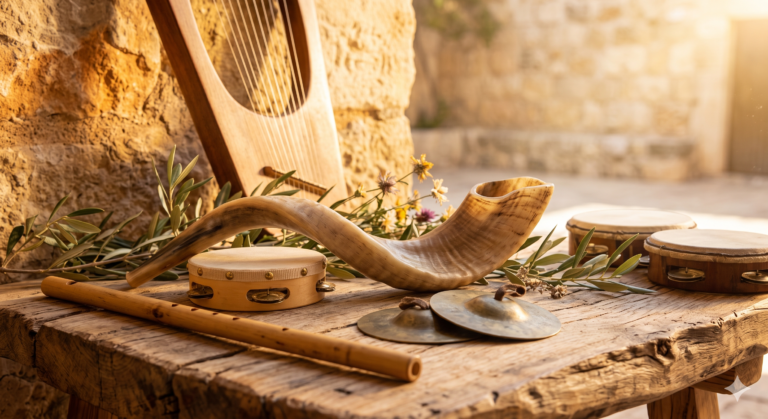
- The closing shofar blast — Yom Kippur ends with a single blast of the shofar — the Tekiah Gedolah — signaling that the day of atonement is complete. The books are sealed. For Messianic believers, this blast echoes the cry of Yeshua on the cross: “It is finished.”
It Is Finished
On the cross, just before He died, Yeshua spoke three words that changed everything:
“It is finished.”
— John 19:30
In Greek, the word is tetelestai. It was a word used to mark a debt as fully paid. It means: completed. Accomplished. Done.
For thousands of years, the High Priest entered the Holy of Holies on Yom Kippur to make temporary atonement that would last one year. Then he would have to do it again. And again. And again. The blood of bulls and goats could cover sin, but it could never take it away (Hebrews 10:4).
Yeshua entered the heavenly Holy of Holies with His own blood and made atonement that will never need to be repeated. The debt is paid. The record is cleared. The veil is torn. The way is open.
We do not observe Yom Kippur because we are trying to earn our atonement. We observe it because our atonement has already been made — and we want to remember, to honor, and to marvel at what it cost and what it accomplished.
“How much more, then, will the blood of Messiah, who through the eternal Spirit offered Himself unblemished to God, cleanse our consciences from acts that lead to death, so that we may serve the living God!”
— Hebrews 9:14
Join Us
If you have never observed Yom Kippur, or if you’ve known it only as a Jewish holiday without understanding its connection to the Messiah, we invite you to join us. There is no more powerful way to understand the cross than to see it through the lens of the Day of Atonement.
And if you’ve been carrying guilt, shame, or the weight of things you’ve done — know this: there is a High Priest who has already entered the Holy of Holies on your behalf. The blood has been applied. The scapegoat has carried your sins into a place of no return. The veil is torn. You can draw near.
We meet every 1st and 3rd Saturday at 12:30 PM at Calvary Baptist Church in Oceanport, NJ. Come as you are.
Questions? Email us at info@kahilatbendavid.org or visit our Contact page.
G’mar Chatimah Tovah — May you be sealed for good.